
We left off in Ruth Chapter 2 last week where Boaz inquired about Ruth and has shown considerable favor towards her. Ruth is astonished and somewhat bewildered by the kindness, generosity, and grace that Boaz is extending to her. And mother-in-law Naomi has newfound hope and is seeing God’s blessings for the first time in a long time.
Ruth 2:23 gives us a bit of a timeframe for the events. “So Ruth stayed close to the women of Boaz to glean until the barley and wheat harvests were finished. And she lived with her mother-in-law.” (Ruth 2:23 NIV)
Barley harvest generally took place in April. The wheat harvest was about four weeks after that.[i] Based on that, we presume Ruth and Boaz encounter one another for a period of at least a month.
Ruth 3:1 NIV “One day Ruth’s mother-in-law Naomi said to her, “My daughter, I must find a home for you, where you will be well-provided for. 2 Now Boaz, with whose women you have worked, is a relative of ours. Tonight he will be winnowing barley on the threshing floor.”
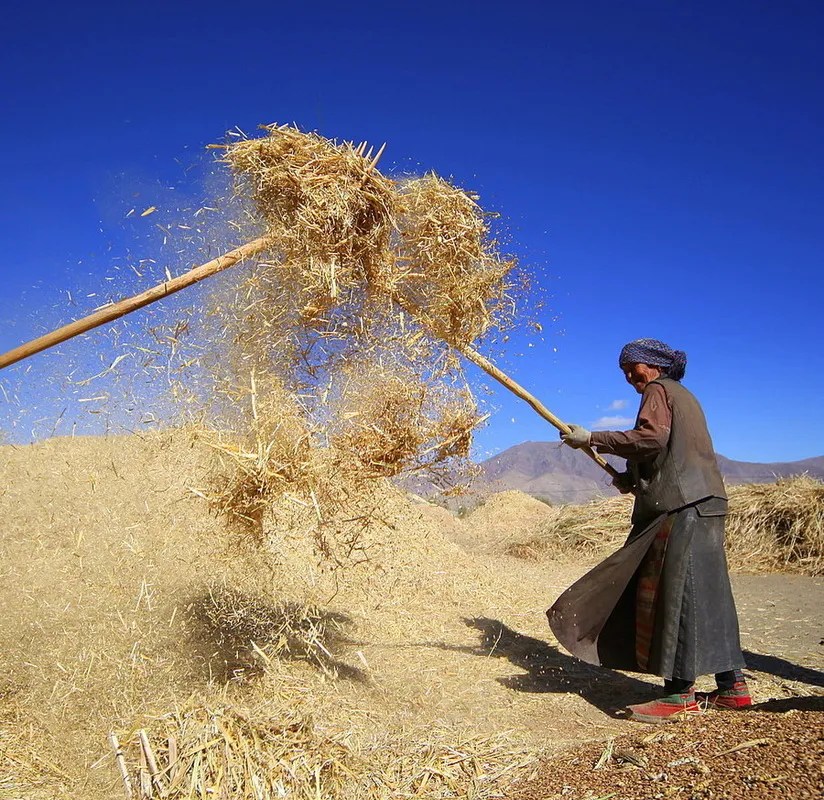
Winnowing was part of the harvest process. Once the barley had been collected from the field, it would be taken to an elevated area. Animals, such as cattle, would be brought in to trample the barley. This would break the barley so that the grain would separate from the husks. Sometimes this process was done without the use of an animal and instead, the men would beat the barley with large sticks. Once the barley had been broken, a large rake would be used to scoop up that which was on the floor. They would toss it into the air. This was usually done at night when the wind would normally blow. As they tossed it into the air, the chaff (or husks) would be carried off by the wind. The grain, the good stuff, because it was weightier, would fall back down the floor. This winnowing is what separated the useful from the useless.
John the Baptist speaks on the winnowing process in Matthew 3. “About this time, John the Baptist appeared, preaching in the Judean wilderness, 2 “Repent, because the kingdom from heaven is near!” “7 But when John saw many Pharisees and Sadducees coming to where he was baptizing,[i] he told them, “You children of serpents! Who warned you to flee from the coming wrath? 8 Produce fruit that is consistent with repentance! 9 Don’t think you can say to yourselves, ‘We have father Abraham!’ because I tell you that God can raise up descendants for Abraham from these stones! 10 The ax already lies against the roots of the trees. So every tree that isn’t producing good fruit will be cut down and thrown into the fire. 11 I am baptizing you with water as evidence of repentance, but the one who is coming after me is stronger than I am, and I am not worthy to carry his sandals. It is he who will baptize you with the Holy Spirit and fire. 12 His winnowing fork is in his hand. He will clean up his threshing floor and gather his grain into the barn, but he will burn the chaff with inextinguishable fire.” (Matthew 3:1-2, 7-12 ISV)
John the Baptist spoke of winnowing because this was a normal practice. Naomi knows the process. She’s probably witnessed it many times in her life. Elimelech, her husband, more than likely winnowed himself. So she knows that once the winnowing occurs, the landowner and his workers (and sometimes family) would sleep there to protect their bounty.

And she’s got an idea.
Ruth 3:3 CEV “Now take a bath and put on some perfume, then dress in your best clothes. Go where he is working, but don’t let him see you until he has finished eating and drinking. 4 Watch where he goes to spend the night, then when he is asleep, lift the cover and lie down at his feet. He will tell you what to do.”
Naomi instructs Ruth to bathe, put on perfume, and change her clothes. This may sound like a common ritual to us, but it was far from that.

Bathing in those days was not as it is today. Generally, we all take at least one bath or shower each day. In Biblical times, bathing wasn’t nearly as frequent as we know it to be. “To us, bathing may seem like a mundane activity. But in biblical Israel, where water was scarce, bathing was often a momentous event.”[ii] Listen to the instructions Jacob gives to his family before they go to build an altar and worship God. Genesis 35:1 GWT “Then God said to Jacob, “Go to Bethel and live there. Make an altar there. I am the God who appeared to you when you were fleeing from your brother Esau.”
2 So Jacob said to his family and those who were with him, “Get rid of the foreign gods which you have, wash yourselves until you are ritually clean, and change your clothes. 3 Then let’s go to Bethel. I will make an altar there to God”.
Under Mosaic law, bathing was a necessary step to take before a special occasion, such as worshipping God. It was symbolic of making oneself pure and presentable.

Ruth is told by Naomi to put on perfume. This was to make herself more pleasing. The perfume would serve as an anointment and, like bathing, would be done before a momentous event. Perfume was special. One of the gifts brought by the wise men to Jesus was frankincense, a perfume. In addition, remember the time that Judas Iscariot was so upset because Mary had anointed the feet of Jesus with expensive perfume? Perfume wasn’t just a mindless addition, applying perfume was intentional for special moments.

Lastly, Ruth is told to dress in her best clothes. She had most likely been wearing clothing signifying that she was in mourning. She wouldn’t have had a large closet of clothing, but she most likely would have had something appropriate for special occasions. Naomi tells her, “It’s time to fix yourself up!” In other words, “Naomi was telling Ruth to act like a bride preparing for her wedding.”[iii]
There is a strong parallel between the relationship between Ruth and Boaz and our relationship with Jesus.
First of all, Boaz was a kinsman. That’s a very important fact. Only a relative, or a kinsman, could redeem Ruth. This had to do with the division of land among the tribes in the Promised Land. A kinsman had to be asked to do the redeeming. But he wasn’t obligated to do so. A kinsman had to be financially able to follow through with the redemption and the cost had to be paid in full. There were no payment plans or loan agreements made. It had to be a final and complete transaction with no loose ends.
Likewise, only Jesus can redeem us. Hebrews 9:15 CEV “15 Christ died to rescue those who had sinned and broken the old agreement. Now he brings his chosen ones a new agreement with its guarantee of God’s eternal blessings!” Redemption isn’t forced upon us; we must ask Him to redeem us. And when He does redeem us, He does so willingly and not because He is forced to do so. And the payment was made in full. Colossians 2:13 CEV assures us. “You were dead, because you were sinful and were not God’s people. But God let Christ make you alive, when he forgave all our sins.
14 God wiped out the charges that were against us for disobeying the Law of Moses. He took them away and nailed them to the cross.”
Then Ruth prepared herself before going to Boaz. She treated the encounter with Boaz as a special occasion and she readied herself for just that.
By the same token, we should prepare ourselves to meet with God. She cleansed and purified herself. 2 Corinthians 7:1 GW “we need to cleanse ourselves from everything that contaminates body and spirit and live a holy life in the fear of God.” Certainly, we know that it is through the blood of Jesus that our sins are washed away; however, “only we can put out of our lives those things that defile us, and we know what they are.”[iv] That is not saying that God doesn’t help us get rid of those things, but we have to be ready to clean house and willing to divorce ourselves from anything that is unpleasing to Him.
Great care was taken before the Israelites went to worship God. They took worship seriously. It was a special occasion. Let’s be honest. For most of us, we treat worship as an ordinary part of our routine. We don’t always make an effort to purify and cleanse our lives before we approach Him. We often forget Who God is as compared to who we are. It’s not to say that we are to approach Him with sinlessness, but we are to approach Him with a willing and repentant heart to be purified of those sins.
Ruth anointed herself with perfume to make herself more pleasing to Boaz.

We’ve been anointed with the Holy Spirit in order to make us more pleasing to God. 1 John 2:27 GW “The anointing you received from Christ lives in you. You don’t need anyone to teach you something else. Instead, Christ’s anointing teaches you about everything. His anointing is true and contains no lie. So live in Christ as he taught you to do.” The Holy Spirit is often compared to a GPS. He stays alert and gives us directions in order to guide us to where and when we need to go. Many times, we don’t listen to the GPS on our phones or in our cars. We question why it’s sending us on backroads, or a journey that is way out of the direction we plan on going, so we just ignore it. We turn the volume down or maybe even just turn it off because, after all, we know what’s best. We take the route that suits us and makes the most sense.
We do the exact same thing with the Holy Spirit. When we feel that nudge to do something or say something that is contrary to our plans, we ignore Him. We turn a deaf ear to Him so that we aren’t disturbed while we do our own thinking. When we rely on our own wisdom and not the guidance of the Holy Spirit, that makes us displeasing to God. I would say that our sinful world and our ways of living have caused us all to suffer from selective hearing. Even if what we are doing isn’t considered bad by the world’s standards, that doesn’t mean it’s pleasing to God. The Holy Spirit keeps us on track with God’s purposes. Dr. A.W. Tozer once said, “If God were to take the Holy Spirit out of this world, much of what the church is doing would go right on; and nobody would know the difference.” We should treasure and utilize the gift of the Holy Spirit far more than we do to make ourselves pleasing to God.
Ruth was told to change her clothes. Clothing, in Biblical times, was quite symbolic. From Genesis, we see that once sin was introduced, it became necessary to hide their nakedness. Kings and members of royalty wore certain colors of clothing to distinguish them from commoners. Those who were in mourning or grieving often wore sackcloth which was uncomfortable and painful. People also tore their clothes in a demonstration of despair and grief. Even in Revelation, clothing is mentioned. Revelation 22:14 HCSB ““Blessed are those who wash their robes, so that they may have the right to the tree of life and may enter the city by the gates.” “We can’t come into God’s presence in our own righteousness, for ‘all our righteousnesses are as filthy rags’ (Isaiah 64:6 KJV).
We can only come in the righteousness of Jesus Christ (2 Cor. 5:21) for we are ‘accepted in the beloved’ (Eph. 1:6 KJV)”[v] Our new clothing, so to speak, is the robe of righteousness.
Once Ruth is cleansed, anointed, and properly clothed, she goes to Boaz.
Ruth 3:5 CEV “Ruth answered, “I’ll do whatever you say.” 6 She went out to the place where Boaz was working and did what Naomi had told her.
7 After Boaz finished eating and drinking and was feeling happy, he went over and fell asleep near the pile of grain. Ruth slipped over quietly. She lifted the cover and lay down near his feet.
8 In the middle of the night, Boaz suddenly woke up and was shocked to see a woman lying at his feet. 9 “Who are you?” he asked.
“Sir, I am Ruth,” she answered, “and you are the relative who is supposed to take care of me. So spread the edge of your cover over me.”

This all seems peculiar to us. We grew up passing notes that read “I like you. Do you like me? Check one. Yes or no.” However strange as it may be to us, Ruth is acting appropriately. Servants often slept at the feet of their keepers. By doing what she did, Ruth was submitting herself to Boaz and proposing marriage. Remember, a kinsman had to be asked to redeem a widow. “She had to put herself at the feet of the lord of the harvest and he would do the rest.”[vi]
Ruth placed herself at the feet of Boaz and made a request. She asked him to spread the edge of his cover over her indicating that he would take her as his bride, take her under his wing and protect her.
It’s a very moving and humbling step that she takes. Certainly, Ruth had to have some boldness to approach Boaz and make this request. But she does so with confidence because she’s gotten to know his character. She’s experienced and witnessed his graciousness. She knows he is qualified and able to redeem her because she’s been told about him. She simply must make her request known to him and then trust him to fulfill her request.
Phillipians 4:6 CEV tells us, “Don’t worry about anything, but pray about everything. With thankful hearts offer up your prayers and requests to God.”
How Ruth approaches Boaz is quite parallel to how we are to approach God. Submitting ourselves to Him, recognizing Him as our Lord, and humbly making our requests known. And then trust Him and be obedient to His instructions.
Ruth 3:10 NIV “10“The Lord bless you, my daughter,” he replied. “This kindness is greater than that which you showed earlier: You have not run after the younger men, whether rich or poor. 11 And now, my daughter, don’t be afraid. I will do for you all you ask. All the people of my town know that you are a woman of noble character. 12 Although it is true that I am a guardian-redeemer of our family, there is another who is more closely related than I. 13 Stay here for the night, and in the morning if he wants to do his duty as your guardian-redeemer, good; let him redeem you. But if he is not willing, as surely as the Lord lives I will do it. Lie here until morning.”
Boaz responds first with the Lord’s blessing over her. And then he speaks to her loyalty and kindness. In fact, he proclaims that this step she has taken is more meaningful than any of the other things she has done. Ruth has proven herself to be a kind, compassionate and loyal daughter-in-law. She’s not done what was expected. And now, with this request, Boaz is full of joy. He knows that he can take care of her and provide for her and he wants nothing more.
David Phelps has written a song entitled, “My Child is Coming Home”. Here are a few of the lyrics.
“Just an ordinary day in Heaven,
Lookin’ down the Streets of
Gold. You can hear the strings
And the angel wings, see the
Saints of Old. Then suddenly
God breaks a smile, and begins
His song, “Look my Son is
Comin’ home!”

Open up the Pearly Gates of
Heaven. Build another mansion
Next to mine. Everybody dance
And shout for joy around the
Throne. Set another place at the
Table. Sound the trumpet loud
And clear this time. Halleluiah, my
Child is comin’ home.”
I love the picture this song paints for us. The image of God smiling, singing, and the preparations He causes to take place because someone, just like you and me, comes to Him for redemption.
Boaz is flattered. He is apparently much older than Ruth and most likely, didn’t consider himself to be the target of her affection. He tells Ruth that she is of noble character. He doesn’t address her Moabite heritage or her past; instead, he speaks of her current condition. And then Boaz does the honorable thing. He tells Ruth that he is willing to redeem her, but here is a closer kinsman who has more entitlement to Elimelech’s property than himself.
Ruth 3:14 NLT “14 So Ruth lay at Boaz’s feet until the morning, but she got up before it was light enough for people to recognize each other. For Boaz had said, “No one must know that a woman was here at the threshing floor.” 15 Then Boaz said to her, “Bring your cloak and spread it out.” He measured six scoops of barley into the cloak and placed it on her back. Then he returned to the town.
16 When Ruth went back to her mother-in-law, Naomi asked, “What happened, my daughter?”
Ruth told Naomi everything Boaz had done for her, 17 and she added, “He gave me these six scoops of barley and said, ‘Don’t go back to your mother-in-law empty-handed.’”
18 Then Naomi said to her, “Just be patient, my daughter, until we hear what happens. The man won’t rest until he has settled things today.”
Boaz doesn’t send Ruth away after she makes her request. He invites her to remain at his feet and she does so. Boaz would have been concerned for Ruth’s safety and for her reputation. Ruth would have been concerned with being obedient.
The next morning, Ruth returns to her mother-in-law with promises and provisions. And Naomi responds with those three little words we love to say, but don’t like to hear. “Just be patient.”
Perhaps Naomi is starting to see God’s providence at work in all of this. Skip Heitzig says that “Providence is God weaving natural events supernaturally.” The move to Moab, the interspiritual faith marriages, the widowhood, the return to Bethlehem, the need for food, the provision of food by means of gleaning, the generosity, and kindness of the landowner who just happens to be a relative, the kinsman law. All of these natural events that God weaves together create something supernatural. The union that will occur between Boaz and Ruth, the redeemer and the foreigner, will result in our Savior and our Redeemer being born.
Ruth had prepared herself and made herself pleasing for Boaz and then she made her request to Boaz. Now she simply needed to be patient for him to do what he needed. The same pattern should be ours when making our requests known to God.

We know and quote Psalm 46:10 often. “Be still, and know that I am God.” It is of no coincidence that “the Hebrew word translated for ‘be still’ means ‘take your hands off, relax”. [vii] If we prepare ourselves to make ourselves pleasing to God and we bow before His feet and make our requests, our next step is to be still, take our hands off and relax. God will take care of you!
[i] https://www.biblegateway.com/resources/encyclopedia-of-the-bible/Barley-Harvest#:~:text=In%20the%20lowlands%20near%20Jericho%20the%20harvest%20usually,fruits%20were%20brought%20to%20the%20Lord%20%28Lev%2023%3A10%29.
[ii] https://www.bibleodyssey.org/people/related-articles/bathing-in-the-hebrew-bible/
[iii] Be Committed by Warren W. Wiersbe
[iv] Be Committed by Warren W. Wiersbe
[v] Be Committed by Warren W. Wiersbe
[vi] Be Committed by Warren W. Wiersbe
[vii] Be Committed by Warren W. Wiersbe
 Beacons of Light