Psalm 30:5b NIV “Weeping may stay for the night,
but rejoicing comes in the morning.”
The book of Ruth certainly proves this to be true. The book of Ruth begins with three funerals and ends with a wedding and a baby.
We left Ruth returning to Naomi after asking Boaz to redeem her by marrying her. Naomi gave Ruth directions to be patient and let Boaz do what needed to be done. And Boaz wastes no time.
That very morning, Boaz goes to the city gate.

A city gate wasn’t just an entrance point to the city It was much more than that. It was normally a large structure that consisted of two points of entry. This provided extra security for one. But it also created a gathering place in between the two entrances that served as the town square. This was where news was spread. Legal transactions were conducted there. Civil and criminal matters would be settled there. Proclamations would be made from there. The city gate was a place of importance.
It’s no wonder that Boaz makes that his first destination for the day.
Ruth 4:1 HCSB “Boaz went to the gate of the town and sat down there. Soon the family redeemer Boaz had spoken about came by. Boaz called him by name and said, “Come over here and sit down.” So he went over and sat down. 2 Then Boaz took 10 men of the town’s elders and said, “Sit here.” And they sat down. 3 He said to the redeemer, “Naomi, who has returned from the land of Moab, is selling a piece of land that belonged to our brother Elimelech. 4 I thought I should inform you: Buy it back in the presence of those seated here and in the presence of the elders of my people. If you want to redeem it, do so. But if you do not want to redeem it, tell me so that I will know, because there isn’t anyone other than you to redeem it, and I am next after you.”
Boaz goes to the city gate and sits down. Maybe this was an ordinary thing for him to do or maybe not. But verse 1 tells us that the closer kinsman just happens to walk by. This is the man that Boaz needed to talk to about Ruth and Naomi. God just happens to send this unnamed kinsman into Boaz’s path on this particular morning.
Knowing the importance of what was about to take place, Boaz gathers ten of the town’s elders and asks them to sit for a certain purpose. “To be witnesses; for though two or three witnesses were sufficient, yet in weightier matters they used more. And ten was the usual number among the Jews in causes of matrimony and divorce, and translation of inheritances; who were both judges of the causes and witnesses of the fact.”[i]
Boaz informs the relative that there is land that once belonged to Elimelech that is available for redemption. In front of these ten witnesses, Boaz acknowledges that this unnamed kinsman has the first choice. And the man says, “I’ll take it.”
Was that what Boaz wanted to hear? Was that what Boaz was expecting to hear? Maybe. Maybe not.
But Boaz is very strategic here. Because once the kinsman accepts the offer, Boaz throws a little mud into this sweet deal.
Ruth 4:5 GNT “5 Boaz said, “Very well, if you buy the field from Naomi, then you are also buying Ruth, the Moabite widow, so that the field will stay in the dead man’s family.”
In chapter 3 of Ruth when she proposes marriage to Boaz, he speaks of her character. He states that throughout the town, she is known as a “virtuous woman”, “a woman of noble character”, and “a respected woman”. Her actions, her demeanor, and her reputation have gained her favor among the Jews in her town. But Boaz conveniently reminds this kinsman that Ruth is a Moabite. This one negative description causes the kinsman to rethink this whole deal. Verse 5 is a major game-changer! This one tidbit of a reminder is the key to releasing the nearest kinsman and giving Boaz the right to redeem.

Ruth 4:6 GNT “6 The man answered, “In that case I will give up my right to buy the field, because it would mean that my own children would not inherit it. You buy it; I would rather not.”
It would seem that this man was already married with children. If he were to take on Ruth and possibly have children with her, that would mess up the inheritance. This bit of land and property that he was willing to purchase wasn’t worth the risk when Ruth the Moabite was considered. And so, he concedes his right to redeem the land.
Ruth 4:7 NKJV “7 Now this was the custom in former times in Israel concerning redeeming and exchanging, to confirm anything: one man took off his sandal and gave it to the other, and this was a confirmation in Israel.”
Verse 7 tells us how things used to be done and we can go to Deuteronomy 25 to fill in the details. “If the man does not want to take his brother’s wife, she must go to the town meeting place and tell the leaders, ‘My husband’s brother refuses to keep his brother’s name alive in Israel. He will not do the duty of a husband’s brother to me.’ 8 Then the leaders of the city must call the man and talk to him. If the man is stubborn and says, ‘I don’t want to take her,’ 9 then his brother’s wife must come to him in front of the leaders. She must take his sandal off his foot and spit in his face. She must say, ‘This is being done to the man who will not give his brother a son!’ 10 From then on, the brother’s family will be known in Israel as, ‘the family of the man whose sandal was removed.’” (Deuteronomy 25:7 ERV”)
Harsh, right?!

By the time this transaction takes place with Boaz and the other kinsman, this is no longer the ritual. There was no spitting in the face. Ruth was not involved. But the unnamed kinsman wants to be certain there is no question that he is relinquishing his right to the property….and to Ruth the Moabite; therefore, he hands over his sandal.
Ruth 4:9 NCV “9 Then Boaz said to the elders and to all the people, “You are witnesses today. I am buying from Naomi everything that belonged to Elimelech and Kilion and Mahlon. 10 I am also taking Ruth, the Moabite who was the wife of Mahlon, as my wife. I am doing this so her dead husband’s property will stay in his name and his name will not be separated from his family and his hometown. You are witnesses today.”
Boaz is a wealthy man. He owns a great deal of property. He doesn’t need more property. He doesn’t necessarily want any more property. What he wants is Ruth.

Jesus tells a parable that so describes this situation. Matthew 13:44 GNT “”The Kingdom of heaven is like this. A man happens to find a treasure hidden in a field. He covers it up again, and is so happy that he goes and sells everything he has, and then goes back and buys that field.”
Boaz saw Ruth as a treasure. He was willing to buy the field so that he could have the treasure.
To find out what takes place in a real estate transaction, we look to Jeremiah 32 where Jeremiah buys family land from his cousin. “9 I bought the field at Anathoth from my cousin Hanamel. I weighed out 17 shekels of silver for him. 10 I signed the deed and had a copy of the deed sealed up. I got some men to witness what I had done, and I weighed out the silver on the scales. 11 Then I took the sealed copy of the deed, which contained the demands and limits of my purchase, and the copy that was not sealed.” (Jeremiah 32:9 ERV)

Based on this, it would be safe to assume that Boaz and this unnamed fellow kinsman would have a title deed drawn up on a scroll. Their names, the agreement, the property, and the stipulations that were involved would be written out. There would be two copies. One would be sealed shut with damp clay or melted wax that was impressed with a carved object. It would remain that way until the property was redeemed by the next kinsman. It was sealed so that no alterations, no additions, no deletions could be made without signs of tampering. It was an authentic representation of the redemption that had taken place.
I can picture Boaz walking away with the sealed deed. Holding onto it tightly. Knowing that what it represented – his new bride, the redemption of Ruth – was just the beginning of their relationship. I imagine him trying not to smile too big, trying to walk casually even though he is feeling a newfound joy from his head to his feet. From the first day he saw her, he was intrigued. He has shown abundant and amazing grace to her and Naomi. And now she is his bride and he is her bridegroom.
This story of Ruth and Boaz seems like a sweet love story, and it is. Ruth is first introduced to us as a mourning widow from a foreign land who does the unthinkable. She leaves behind her old life as a Moabite and follows her mother-in-law to Bethlehem. By God’s providence, Ruth goes to glean in the fields belonging to a kinsman who showed enormous grace and generosity. Ruth goes to Boaz and asks for redemption and Boaz is willing and able to do just that. God continues to work throughout their relationship to accomplish His purposes. It is a sweet love story, but it’s more than just that.
Take a look at some of the parallels between Boaz and Jesus.
| Jesus | Boaz |
| From tribe of Judah | From tribe of Judah |
| From Bethlehem | From Bethlehem |
| Redeemer/Kinsman for all | Redeemer/Kinsman of Ruth & Naomi |
| Redeems Gentiles and Jews | Redeemed a Gentile and a Jew (Ruth/Naomi) |
| Takes a bride through redemption | Took a bride through redemption |
| Redemption was done publicly | Redemption was done publicly |
| The deed of redemption was forever sealed | The deed of redemption was sealed |
| Was able to redeem by being related, asked, able & willing | Was able to redeem by being related, asked, able & willing |
| Shows abundant grace | Showed abundant grace |
| Provides and blesses | Provided for and blessed Ruth & Naomi |
| He became man, came from Bethlehem and was willing to sacrifice to get the treasure of a Gentile bride for Himself | He was a man from Bethlehem who was willing to buy the field to get the treasure of a Gentile bride for himself. |
This story of Boaz and Ruth is our story with Jesus. “The key theme of this chapter is redemption.´ The words “redeem,” “buy,” and “purchase” are used at least fifteen times. There can be no redemption without the paying of a price. From our point of view, salvation is free to “whosoever shall on the name of the Lord” (Acts 2:21 KJV), but from God’s point of view, redemption is a very costly thing.”[ii]
We aren’t told how Ruth responds to being redeemed, but Naomi’s reaction to what takes place quite possibly gives us some insight.
Boaz and Ruth are blessed with a son. Ruth 4:14 CEV “ 14 After his birth, the women said to Naomi:
Praise the Lord! Today he has given you a grandson to take care of you. We pray that the boy will grow up to be famous everywhere in Israel. 15 He will make you happy and take care of you in your old age, because he is the son of your daughter-in-law. And she loves you more than seven sons of your own would love you.
16 Naomi loved the boy and took good care of him. 17 The neighborhood women named him Obed, but they called him “Naomi’s Boy.”
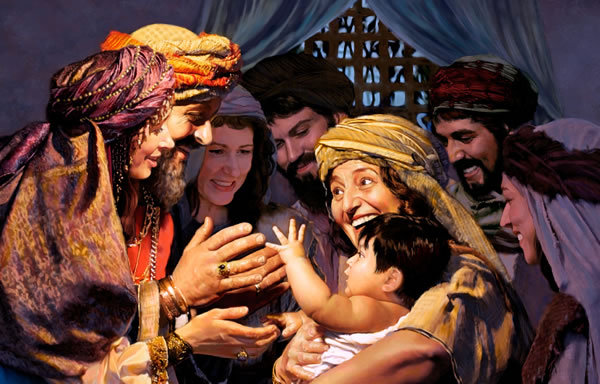
There is a sweetness to this when you picture Ruth seeing Naomi holding Obed, caring for him, and showing him off to the other women. Ruth, as it was said, loved Naomi more than seven sons could have loved her. Ruth had been there for Naomi in tough times and was now able to enjoy Naomi in some blessed times. Ruth has gone through a lot of major changes. “She went from loneliness to love, from toil to rest, from poverty to wealth, from worry to assurance, and from despair to hope. She was no longer ‘Ruth the Moabitess,’ for the past was gone and she was making a new beginning. She was now ‘Ruth the wife of Boaz,’ a name she was proud to bear.”[iii] She experienced these changes because she trusted Boaz with her redemption.
If we compare Boaz the redeemer to Jesus the redeemer, then we must compare Ruth the redeemed to us the redeemed.
| Ruth | Us |
| An immigrant | 1 Peter 2:11 calls us immigrants |
| Willingly left her old life behind | Eph. 4:22 tells us to leave behind our old life |
| Obedient to God’s prompting to go to Boaz’s field | Prov. 3:5 assures us that if we trust the Lord, He will direct our steps |
| Despite her heritage (past) she proved herself to be of noble character | Prov. 31 is our go-to manual on being a woman of noble character |
| Ready to work hard | Prov. 31:17 describes a woman who is hard-working, strong, and industrious |
| Showed humility | Micah 6:8 informs us that God wants us to act justly, love mercy, and walk humbly with Him |
| Showed thankfulness | 1 Thess. 5:18 reminds us to give thanks in all things |
| Accepted grace given to her | Heb. 4:16 is so reassuring “So whenever we are in need, we should come bravely before the throne of our merciful God. There we will be treated with undeserved grace, and we will find help.” |
| Asked to be redeemed | 1 John 1:9 assures us that if we confess our sins and ask for forgiveness and redemption, He will make us clean |
| Submitted herself to be used for God’s purposes | Heb. 13:21 persuades us to allow God to equip us with everything good for doing His will |
| Found herself to be richly blessed far beyond what she could have imagined | 2 Cor. 9:8 reminds us that God is able to bless us abundantly |
Ruth’s story is our story. If you find yourself not knowing know what to do, be a Ruth.
“Be a Ruth, loyal in all your relationships, willing to walk the extra mile & don’t quit when things get tough. Someday, you’ll see why it was all worth the effort.” (Unknown)
[i] https://biblehub.com/commentaries/ruth/4-2.htm (Benson Commentary)
[ii] Be Committed by Warren W. Wiersbe
[iii] Be Committed by Warren W. Wiersbe
 Beacons of Light