
This week we will continue studying what is expected of believers on this journey of faith in Jesus. Christ commands us to love the people in our lives, looking for ways to extend God’s love to them by loving unconditionally. We are free to love others in this manner when we love the Lord unconditionally and without reservations.
- How do you express your love to God? How does He know that you love Him?
Multiple scriptures tell us how to show our love to God. John 14:15 GW “If you love me, you will obey my commandments.”
- How do you express the love of God to others? What tangible ways do you use to extend His love to those around you?[i] We tell people that we love them but it’s often more believable and meaningful when we show people that we love them. This is done in multiple ways – praying for and with them, being there for them at all times, listening and paying attention to them, rejoicing in their victories and accomplishments, accepting them as they are, and not trying to make them into who you want them to be.
Today’s scripture comes from Luke 10:25 NIV “25 On one occasion an expert in the law stood up to test Jesus. “Teacher,” he asked, “what must I do to inherit eternal life?”
It’s a great question but the motivation behind it is bad. This expert or scri(be as he’s referred to in some translations) is intent on testing Jesus. He inquires about what he needs to do to gain eternal life. We tend to think of the concept of eternal life in the context of the New Testament, but there are several references to eternal life in the Old Testament. Jesus refers to this when He responds to the scribe.
26 “What is written in the Law?” he replied. “How do you read it?”
27 He answered, “‘Love the Lord your God with all your heart and with all your soul and with all your strength and with all your mind’[c]; and, ‘Love your neighbor as yourself.’[d]”
28 “You have answered correctly,” Jesus replied. “Do this and you will live.” (Luke 10 NIV)
The scribe knows the Law. He quotes from Deuteronomy 6:5 and Leviticus 19:18. He knows to what Scripture Jesus is referring. He has the head knowledge. What he’s lacking is heart knowledge.

Jesus states that his answer is correct and that he will have eternal life if he follows those instructions. The instructions in verse 27 sound easy enough, don’t they? Love the Lord your God with all your heart. Love Him with all your soul. Love Him with all your strength. Love Him with all your mind. And love your neighbor just like you love yourself. The problem is that we are sinners living in a sinful world. We are humanly incapable of fulfilling those requirements because of our sinful nature. Jesus is subtly telling this knowledgeable man that it is impossible for sinners to gain eternal life just by following the Law. Romans 3:19 ICB “19 The law commands many things. We know that those commands are for those who are under the law. This stops all excuses and brings the whole world under God’s judgment, 20 because no one can be made right with God by following the law. The law only shows us our sin.”
This scribe, who we can assume was a Pharisee since Sadducees don’t believe in eternal life[ii], doesn’t question the loving of God with 100% of all that he is – heart, soul, strength, and mind. He seems to feel confident that he meets the requirements there. But he does ask for clarification as to who is his neighbor.
Luke 10:29 LSV “And he, willing to declare himself righteous, said to Jesus, “And who is my neighbor?”
Elliot’s commentary on this is telling. “But there were misgivings as to the second commandment, and, as if feeling that there had been a tone of rebuke in our Lord’s answer, he vindicates himself by asking the question, “Who is my neighbour?” No one, he thinks, could accuse him of neglecting his duties to those who lived in the same village, attended the same synagogue, who were Pharisees like himself, or even Israelites.”[iii]
Rather than define “neighbor” to the Pharisee, Jesus uses a parable to answer.
Luke 10:30 NIV “30 In reply Jesus said: “A man was going down from Jerusalem to Jericho, when he was attacked by robbers. They stripped him of his clothes, beat him and went away, leaving him half dead. 31 A priest happened to be going down the same road, and when he saw the man, he passed by on the other side. 32 So too, a Levite, when he came to the place and saw him, passed by on the other side. 33 But a Samaritan, as he traveled, came where the man was; and when he saw him, he took pity on him. 34 He went to him and bandaged his wounds, pouring on oil and wine. Then he put the man on his own donkey, brought him to an inn and took care of him. 35 The next day he took out two denarii[e] and gave them to the innkeeper. ‘Look after him,’ he said, ‘and when I return, I will reimburse you for any extra expense you may have.’
36 “Which of these three do you think was a neighbor to the man who fell into the hands of robbers?”
The man, the victim in verse 30 isn’t categorized in any way. Jesus purposefully doesn’t describe or identify any labels of this man. We don’t know if he is old or young. We don’t know the color of his skin. We don’t know if he is married or single. We don’t know if he has a trade or occupation. We don’t know if he was rich or poor. There is no information given that should lead to prejudice or discrimination. All that we do know is that he was a man who was attacked, robbed, stripped, beaten, and left for dead.
The story that Jesus tells is not unrealistic. It is believed that thousands of priests and Levites lived in Jericho and conducted business in Jerusalem and, as a result, many would be found traveling on that road at any given time. The priest notices the beaten man and passes to the other side. The Levite does the same thing. It could have been that both the priest and Levite were adhering to the Mosaic Law and didn’t want to risk becoming unclean should the man die. If that was the case, then both men chose the law over compassion for another human being.
Several chapters later in Luke 14, Jesus sheds light on this. On the Sabbath Jesus encounters a man suffering from dropsy or, as we know it, edema. Luke 14:3 NIV “3 Jesus asked the Pharisees and experts in the law, “Is it lawful to heal on the Sabbath or not?” 4 But they remained silent. So taking hold of the man, he healed him and sent him on his way.
5 Then he asked them, “If one of you has a child or an ox that falls into a well on the Sabbath day, will you not immediately pull it out?” 6 And they had nothing to say.”
Jesus was demonstrating to them that their abidance to the law was conditional. If breaking the law meant saving or rescuing someone or something they loved, then so be it. But many of them used the law as an excuse not to show compassion or to do what was right.
Going back to the parable, Jesus uses a priest and a Levite as examples of those who have the head knowledge but lack the heart knowledge of what it means to be a Christian. And in verse 33 of Luke 10, Jesus dares to use a dirty word. The “s” word – Samaritan.
Samaritans were despised by the Jewish people. So much so that Jews would avoid them at all costs. Remember the woman at the well who was shocked that Jesus even made eye contact with her since He was a Jew, and she was a Samaritan. The animosity the Jews had for the Samaritans was fierce. It was the very definition of prejudice. So, for Jesus to use a Samaritan in this story AND to make him the hero takes this parable in an unexpected way.
Whereas the priest and Levite only walked past the man on the other side of the road, take note of all that the Samaritan man did.

- He saw him.
- He took pity on him.
- He went to him.
- He bandaged his wounds.
- He treated the wounds with oil and wine.
- He put the man on his own donkey.
- He took him to an inn.
- He took care of him.
- He gave money to the innkeeper.
- He returned to settle any debt the man incurred.
I just named ten separate things this Samaritan did for the wounded man. If he had seen him, took pity on him, went to him, and bandaged and treated his wounds, we would think the Samaritan had done a good deed. If he had done all of those things and put him on his donkey and taken him to an inn, we would have considered he went the extra mile. But he doesn’t stop with just those things. He takes care of him physically and financially. He even makes a return trip to take care of any extra expenses. The Samaritan doesn’t just do the minimum. He goes way beyond what could have been expected.
Jesus asked the scribe who, out of the three – the priest, the Levite, or the Samaritan – who was this man’s neighbor.
Luke 10:37 HCSB “37 “The one who showed mercy to him,” he said. Then Jesus told him, “Go and do the same.”
The scribe couldn’t even bring himself to say “Samaritan” but he knew and understood that the Samaritan was the only one who had shown mercy. He understood that the two men of God – the priest and the Levite – failed to show compassion. He understood that the Samaritan was the one who treated this man like his neighbor. Did you know that the word “neighbor” is mentioned in the Bible more than 140 times? “Love your neighbor as yourself.” (Galatians 5:14) “Love does no harm to a neighbor.” (Romans 13:10) “Let no one seek his own good, but the good of his neighbor.” (1 Corinthians 10:24)
In telling this parable, Jesus explains that we love our neighbor when we feel compassion towards them. We love our neighbor when we go the extra mile, and do what is more than expected. But who is our neighbor?
The Biblical definition of neighbor is: “NEIGHBOR (רֵעַ֮, H8276, friend, שָׁכֵן, H8907, fellow-citizen, עָמִית, H6660, associate; πλησίον, G4446, one close by, γείτων, G1150, one occupying adjoining ground).”[iv]
A neighbor, therefore, can be anyone. Someone standing in line next to you at the grocery store. A person stopped at the red light next to you. A co-worker whose cubicle is near yours. The person who delivers your mail. All of these people whose paths cross yours are neighbors. So then the question is – are we loving our neighbors?
See if these words sound familiar.


“It’s a beautiful day in this neighborhood
A beautiful day for a neighbor
Would you be mine? Could you be mine?
It’s a neighborly day in this beauty wood
A neighborly day for a beauty
Would you be mine? Could you be mine?
I have always wanted to have a neighbor just like you
I’ve always wanted to live in a neighborhood with you
So, let’s make the most of this beautiful day
Since we’re together, we might as well say
Would you be mine? Could you be mine?
Won’t you be my neighbor?
Won’t you please, won’t you please?
Please, won’t you be my neighbor?
Neighbors are people who are close to us
And friends are people who are close to our hearts
I like to think of you as my neighbor and my friend”[v]
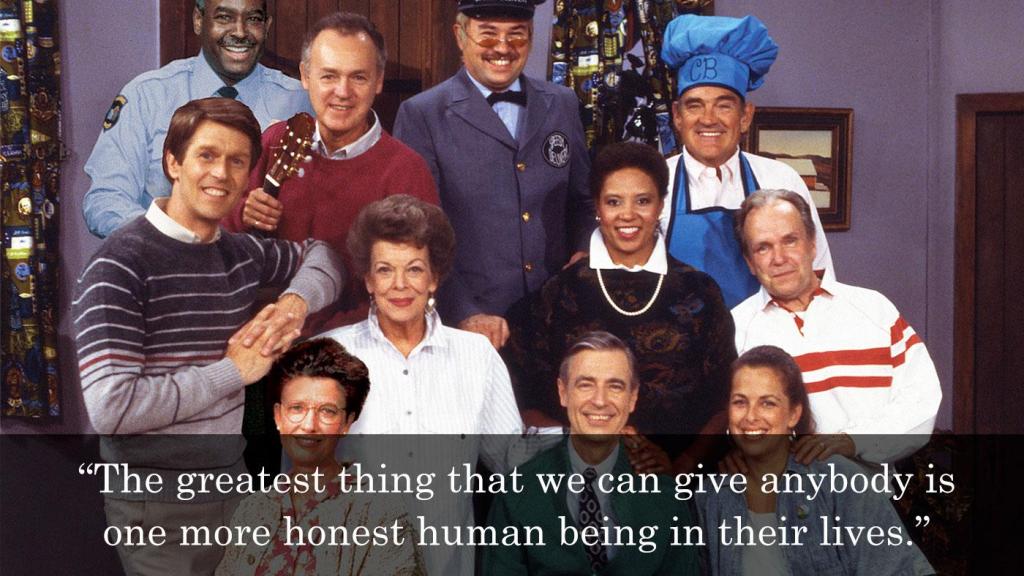
Most of us are very familiar with that song and its lyrics. Mr. Roger’s Neighborhood ran for 31 seasons.
Here are some interesting facts about Mr. Rogers and his show that you may or may not know.
Fred Rogers was an ordained Presbyterian minister.
His mother knitted all his sweaters.
He was colorblind.
He was bullied as a child.
He also responded to every letter written to him by a child and he never threw away any letter or picture sent to him.[vi]
Mr. Rogers was the epitome of a good neighbor.
“All of us, at some time or other, need help. Whether we’re giving or receiving help, each one of us has something valuable to bring to this world. That’s one of the things that connects us as neighbors—in our own way, each one of us is a giver and a receiver.”
fred rogers
“Mister Rogers didn’t call us “acquaintances” or “friends”; he didn’t call us “boys and girls” or “ladies and gentlemen.” He called us neighbors.
“Neighbor” is biblical language, which Fred knew well.
When Mister Rogers called us neighbors, when he hosted us in his own Neighborhood for over 30 years, he was calling us—gently but firmly—out of our structures of power and our silos of sameness, into lives of mercy and care for one another.
Admittedly, maybe he was overly optimistic. Maybe he was calling us something better than we actually were. But maybe he believed that if he got to us while we were young, if he told us, again and again, that we were good, that we were lovable, and that we could extend mercy, maybe we could grow into real neighbors to one another.
Maybe we still can.”[vii]
Some neighbors are easy to love. Others; not so much. The Samaritan demonstrates to us that we have what is needed to love the unlovable. I’ve been seeing this quote lately and it resonated with me. “The real test of Christianity is not loving Jesus, it’s loving Judas.” (Unknown)
Every day, our paths cross with our neighbors whether we know them by name or not. And every day, every encounter provides us with an opportunity to show God’s love. We may never know what God does with the smiles, the “hope you have a great day!” sentiments, the demonstrations of compassion and caring, but we can be assured none of it is ever wasted.
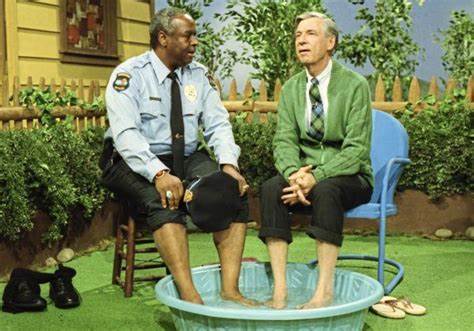

“If you could only sense how important you are to the lives of those you meet; how important you can be to the people you may never even dream of. There is something of yourself that you leave at every meeting with another person.” – Fred Rogers

[i] Credit to Andy Cauble
[ii] Pharisees, Sadducees & Essenes (jewishvirtuallibrary.org)
[iii] Luke 10:29 But wanting to justify himself, he asked Jesus, “And who is my neighbor?” (biblehub.com)
[iv] Neighbor – Encyclopedia of The Bible – Bible Gateway
[v] Won’t You Be My Neighbor by Fred Rogers
[vi] 15 fun facts about Mister Rogers and his neighborhood – pennlive.com
[vii] Seven Lessons from Mister Rogers That Can Help… (berkeley.edu)
 Beacons of Light