I want you to take a trip down memory lane. I want you to think of a teacher who had a profound impact on your life. A teacher who helped to mold you into who you are today. What are some of the characteristics of this teacher?
Encouraging
Supportive

Patient
Nurturing
Kind
Loving
Caring
Passionate
Interested
Knowledgeable
Intuitive
Most of us have at least one teacher that comes to mind when we think of a great, influential teacher. Someone who wasn’t just there for the paycheck, but rather, was passionate about teaching. Someone who cared if their students actually learned what was being taught. One who loved teaching and loved on those whom they taught.
“A teacher takes a hand, opens a mind, and touches a heart.” Unknown
Scripture tells us that the Holy Spirit serves many purposes in our lives. He is our Comforter, Counselor, Sealer, Guarantee, Conscience, Strength, Interceder, Sanctifier, Restorer, and our Teacher. In John 14:26 GWT, Jesus tells His followers, “26 However, the helper, the Holy Spirit, whom the Father will send in my name, will teach you everything. He will remind you of everything that I have ever told you.”
It’s important to understand the context of this statement. Jesus is spending time with His disciples just hours before His arrest. He knows what’s about to take place and He tries to prepare His followers as much as humanly possible since they would have been unable to really understand what was about to occur and what He was saying. He tells them He will be with them for only a short while longer and then He’ll be gone. They won’t be able to go with Him. He talks with them about preparing a place for them and that He will return to take them back to be with Him. He says in John 14:4 GWT “You know the way to the place where I am going.”
5 Thomas said to him, “Lord, we don’t know where you’re going. So how can we know the way?”
I love Thomas’ transparency of just not getting it, don’t you?
In the next few verses, Jesus speaks clearly that if they have seen Him, they’ve seen the Father because He is in the Father and the Father is in Him. To be fair to the apostles, this isn’t easily understandable, is it? What Jesus is saying is 100% true, but with our finite minds, it’s difficult to fully grasp the concept. Jesus, a human man they’ve seen and are witness to His existence. God, their Creator they’ve been taught to worship. And now, Jesus is about to bring in the Holy Spirit. “The mind of man cannot fully understand the mystery of the Trinity. He who has tried to understand the mystery fully will lose his mind; but he who would deny the Trinity will lose his soul.”[i] (Harold Lindsell)
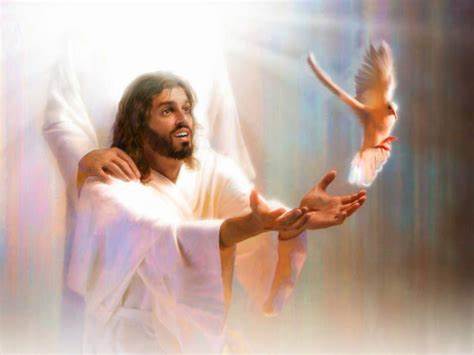
The idea of the Trinity is mind-boggling and is difficult to articulate. As Christians, we pretty much get to an understanding that we cannot understand it; we cannot fully comprehend it. As a result, we get to a point where we just accept that it is what God’s Word says it is even though we can’t explain it. Truthfully, we most likely have a visual of God (although it is probably not even close to reality) of a long white robe, long white beard, and radiant, blinding light. The same is true of Jesus (tall, dark and wavy hair, brown eyes, gentle smile). But then when it comes to the Holy Ghost, it’s either a dove or a gust of wind, right? The Holy Spirit is more of an enigma or mystery to us than God or Jesus. Not only that, but it seems that God and Jesus have proper names, while the Holy Spirit seems to be an impersonal reference. Kind of like “The good coach.” “The nice lady.” “The kind teacher.” The term “Holy Spirit” seems more descriptive than if He had a name. Perhaps we could relate to Him more if He had a name, such as Gus or Hal. Not to be sacrilegious in any way, but the Holy Spirit is truthfully more difficult for us to grasp.
“Sometimes the Personhood of the Father and Son is appreciated, but the Personhood of the Holy Spirit is neglected. Sometimes the Spirit is treated more like a “force” than a Person. But the Holy Spirit is not an “it,” but a “he” (see John 14:26; 16:7–15; Acts 8:16). The fact that the Holy Spirit is a Person, not an impersonal force (like gravity), is also shown by the fact that he speaks (Hebrews 3:7), reasons (Acts 15:28), thinks and understands (1 Corinthians 2:10–11), wills (1 Corinthians 12:11), feels (Ephesians 4:30), and gives personal fellowship (2 Corinthians 13:14). These are all qualities of personhood.”[ii]
In verse 16, Jesus speaks of the Father and the Holy Spirit.
John 14:16 CEV “Then I will ask the Father to send you the Holy Spirit who will help you and always be with you. 17 The Spirit will show you what is true. The people of this world cannot accept the Spirit because they don’t see or know him. But you know the Spirit, who is with you and will keep on living in you.”
Jesus offers the Holy Spirit to His followers because He’s about to leave them. He’ll tell them in the very next verse that He is not going to leave them as orphans. He’s not going to leave them without a Helper, a Comforter, or One Who will continue to teach them.
We’ve all had people leave us in some way or another. Whether we’ve had a special co-worker who took another job, a friend who moved to a different state, or a family member who passed away. We’ve experienced the void left by someone important to us. Over time, we learn to live without the day-to-day interaction with that person. Those of you who have experienced the death of someone close have more than likely picked up the phone to call that person before realizing that they’re not going to answer. It’s a hard dose of truth, isn’t it? Because when someone is central to your life, so much of your life revolves around or involves them in some way.
Jesus understands that His leaving will create a massive void. He knows that His followers (then and now) need an ever-present Spirit; One Who will fill that void. John 14:16 NKJV “And I will pray the Father, and He will give you another Helper, that He may abide with you forever—”
“The key is the word here “another.” It’s from the Greek word allos and it means, not one who is just additional, or even simply resembles another, but one who is identical in every way, or one who is an exact duplicate.”[iii]
What Jesus is telling them is that He and the Father are the same. When you’ve seen Jesus, you’ve seen God. Now a Helper Who is identical to Jesus is coming. Three in One; One in Three.
Imagine if you were listening to Jesus as He said these things. These friends and followers of Jesus had been able to see Him, touch Him, hear Him, ask Him questions, and hear His answers. They’ve watched Him in action and witnessed miracles. He had simply said to each of them, “Follow Me” and they did. Leaving everything in their lives behind, they had followed Him. Where they went, where they stayed, what they took, what they did, what they heard, what they witnessed almost always had Jesus at the center. And now, Jesus tells them He’s leaving them. In a way that some can understand, they’ve just been told they’re about to be empty nesters, in a sense.
Empty nesters are often thought of as parents who find themselves without children living in the home any longer. But I’ve often thought it goes beyond that. If you’ve had a parent or family member who required constant care and then passed away, there’s a feeling of an empty nest. When so much of your time, energy, and attention is focused on the care of someone else and they’re no longer in need of that, you can feel somewhat lost. The symptoms that are associated with empty nesters are anxiety, sadness, loneliness, and most commonly, a lack of purpose.
Imagine what’s going through the minds of these apostles. They’ve given up everything to join Jesus in His journey and His ministry. When they first dropped their nets and left their families, they probably didn’t know how long they’d be gone. After some time, with Jesus becoming more and more known and certainly more in demand, the apostles may have considered this to be a long-term commitment. Perhaps they saw themselves 10 or 20 years down the road, still traveling with Jesus, witnessing miracles, and absorbing the meanings of His parables. But now He’s leaving them? Certainly, they were experiencing feelings of anxiety, sadness, potential loneliness, and confusion about their purpose.
They could barely process the fact that He was about to go away before He told them that He would ask the Father to send another Helper, the Holy Spirit. And unlike Jesus Who they knew to be flesh and bones and limited in the body of a man, the Holy Spirit would come to them and would never leave them. Do you ever think about the fact that you are never alone?
Not only would the Holy Spirit always be with them and be a Helper, but the Holy Spirit would teach them all things and remind them of all that Jesus had said. Just think about that for a moment. We have been given the gift of the Holy Spirit Who will never leave us, teach us all things, help us to remember the Word of God, and intercede on our behalf.
And yet, how engaged are we with the Holy Spirit who not only is with us but also in us?

A good indicator of that is how much we are learning. If you were to look back this time last year, how much have you learned in this past year? Has there been growth? Are you more like Jesus today than you were this time last year? Are you permitting the Holy Spirit to teach you? Is it possible we don’t learn from the Holy Spirit as much as we should because we simply don’t understand the importance of the Holy Spirit in our lives?
You see, the Holy Spirit is there to teach, but we must be willing to learn.
Think back to your days in school. It wasn’t enough to just show up and be counted as present. Just because you may have had perfect attendance didn’t mean you were learning. It didn’t mean you’d pass your tests and exams. It didn’t mean you understood what was being taught and certainly didn’t mean you knew how to apply it.

I can remember taking Geometry in Junior High. I was in class every day. I took some notes, did my homework, and tried to appear as if I was paying attention to the teacher. But honestly, I vividly remember thinking, “This is useless. I am never going to need this information in my life.” I memorized enough to pass the class, but I didn’t learn anything about geometry.
I felt somewhat proud of my grades because, at the least, I had shown up to class and memorized enough to pass the class. I determined myself to be better than those who didn’t even bother to show up.
Have you heard the term “truancy”? It’s used to refer to someone who is “intentional, unjustified, unauthorized, or illegal absence from compulsory education. It is a deliberate absence by a student’s own free will.”[iv] There are laws governing school attendance because it’s important for students to be present. Georgia Department of Education says, “Data indicate(s) that missing more than five days of school each year, regardless of the cause, begins to impact student academic performance and starts shaping attitudes about school.”[v]
Some of us go through our Christian lives as a truant. Deliberately absent by our own free will. The origin of the word “truant” means “one who wanders from an appointed place.”[vi] Not just physically wander, but emotionally and intellectually.
Some of us don’t want to be or don’t think we need to be taught by the Holy Spirit. We wander from our appointed spiritual place. We don’t show up to truly learn. We desire just enough to pass the tests life gives us. Jesus told His followers that the Holy Spirit would remind them of what Jesus had told them. Likewise, the Holy Spirit will remind us of God’s Word at just the right time. “But we also have a responsibility to hide God’s Word in our hearts! The text says that He brings to remembrance the things that He has said, but we must be familiar with the Word in order for it to be a reminder.”[vii]
1 John 2:27 NLT “But you have received the Holy Spirit, and he lives within you, so you don’t need anyone to teach you what is true. For the Spirit teaches you everything you need to know, and what he teaches is true—it is not a lie. So just as he has taught you, remain in fellowship with Christ.”
When we read, study, and store away God’s Word, the Holy Spirit can use that to teach us. The Bible is a Spiritual book and it requires the Holy Spirit to help us understand it and make application in our lives and our circumstances. It’s more than head knowledge of God’s Word, it’s heart knowledge.
“Head knowledge” is often associated with knowledge limited to the level of information, without any practical implications or impact in someone’s life. On the other hand, “heart knowledge” is associated with that information that results in transformation in someone[‘s] life. It may also refer to the emotional impact that results from information, such as joy that results from the knowledge of God’s love. Head knowledge is usually considered pejorative [disparaging or belittling] [viii]; heart knowledge, conversely, is generally favorable”[ix]

The Holy Spirit takes our head knowledge and transforms it into heart knowledge.
And this is done through all of the characteristics that a good teacher possesses. He teaches us through encouragement, conviction, and truth. “The Spirit of God speaks not from His authority, but from the authoritative Word of God! It is the authority of God Himself with which the Spirit of God guides all believers!”[x]
We can’t have a relationship with Jesus and not have one with the Holy Spirit. We can’t have a relationship with God and not have one with Jesus. C.H. Spurgeon discussed the intricate interweaving of the Trinity. “See how divinely they work together, — how the Father glorifies the Son, how the Holy Spirit glorifies Jesus, how both the Holy Spirit and the Lord Jesus glorify the Father! These Three are One, sweetly uniting in the salvation of the chosen seed.”[xi]
In some of Jesus’ last words, He spoke of the Holy Spirit and His power.
Acts 1:7 CEV “Jesus said to them, “You don’t need to know the time of those events that only the Father controls. 8 But the Holy Spirit will come upon you and give you power. Then you will tell everyone about me in Jerusalem, in all Judea, in Samaria, and everywhere in the world.” 9 After Jesus had said this and while they were watching, he was taken up into a cloud. They could not see him, 10 but as he went up, they kept looking up into the sky.”

Most of us carry cell phones that don’t just make phone calls. The devices enable us to send messages, order things, look up information, tell us how to get somewhere, keep up with our to-do lists, and basically almost anything we could imagine. But they must be charged on a regular basis. We have to connect our devices to a power source to be recharged so that they can do what it’s supposed to do. There are frequent updates to our cell phones. But have you ever tried to update your cellphone without enough of a power charge? It won’t let you. You’ll get a message telling you to plug in your device to get more power so that the device can be refreshed and updated. Jesus left His followers with the greatest power source ever known to man – the Holy Spirit. Some of us are trying to make it through life with a dead battery. We haven’t been refreshed or updated in so long that we can’t do what we are supposed to do because we haven’t plugged into our power source. It’s not enough for your cell phone to be near the power outlet; it must be plugged in or connected to the source of power to be recharged. It’s not enough for us to just be near, we need to connect with the Holy Spirit.
“ The Spirit-filled life is not a special, deluxe edition of Christianity. It is part and parcel of the total plan of God for His people.”
A.W. Tozer
[i] The mind of man cannot fully understand the mystery of the Trinity. He who has tried to understand the mystery fully will lose his mind; but he who would deny the Trinity will lose his soul. – Grace Quotes
[ii] What Is the Doctrine of the Trinity? | Desiring God
[iii] The Holy Spirit Is Here to Help When You Need It – Topical Studies (biblestudytools.com)
[v] Student Attendance (gadoe.org)
[vi] truancy | Etymology, origin and meaning of truancy by etymonline
[vii] Credit to Andy Cauble
[viii] Pejorative Definition & Meaning – Merriam-Webster
[ix] Head Knowledge vs. Heart Knowledge: Fine Distinctions or False Dichotomies? – DAVID I. YOON (davidiyoon.com)
[x] Credit to Andy Cauble
[xi] The Spurgeon Library | The Holy Spirit Glorifying Christ
 Beacons of Light