Last week, we discussed the first two churches in the letter that Jesus had John send to seven specific churches in Asia Minor.
Ephesus, the careless or loveless church whose members were doing a lot of good things and working tirelessly, but they had lost their first love for Jesus. He commended them on many things they were doing right, including their hatred of the deeds of the Nicolaitans that were in their midst. The Nicolaitans are going to show up again in our study today.
Smyrna was the second church that was addressed. Smyrna was the crowned church. Jesus didn’t have any admonishments for them. They had suffered and been persecuted on many levels, but they had remained faithful to Him.
The third church addressed is Pergamos or Pergamum, the compromising church.
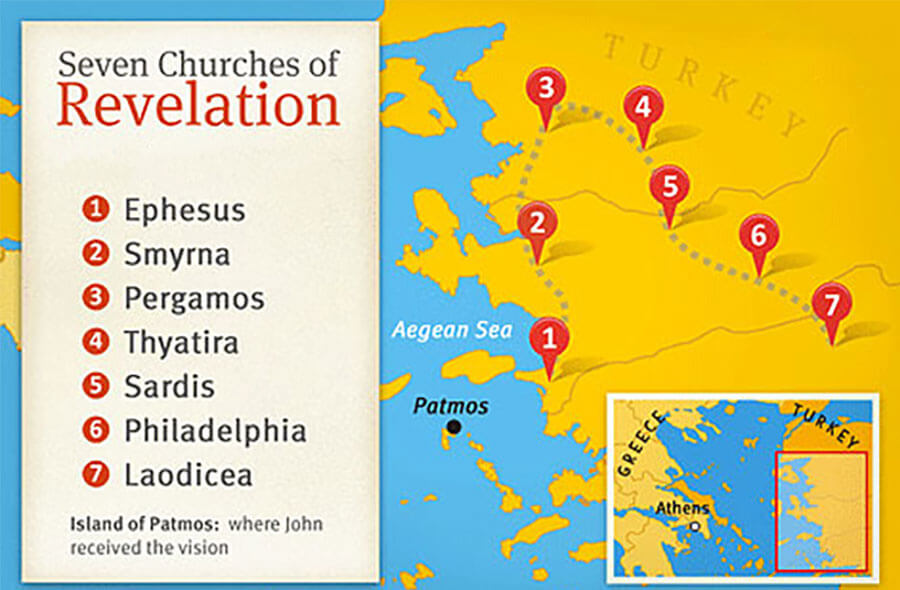
As we discussed last week, Ephesus means “desirable”. This indicates that the church at Ephesus was the desirable church.[i] Smyrna means “bitter” and “strong”[ii] which testifies to their steadfast faith despite their sufferings.
Pergamos means “mixed or objectionable marriage”.[iii] (Monogamous means having one mate at a time; polygamous means having multiple mates at the same time.)
Revelation 2:12 NKJV “12 “And to the angel of the church in Pergamos write,
‘These things says He who has the sharp two-edged sword: 13 “I know your works, and where you dwell, where Satan’s throne is. And you hold fast to My name, and did not deny My faith even in the days in which Antipas was My faithful martyr, who was killed among you, where Satan dwells. 14 But I have a few things against you, because you have there those who hold the doctrine of Balaam, who taught Balak to put a stumbling block before the children of Israel, to eat things sacrificed to idols, and to commit sexual immorality. 15 Thus you also have those who hold the doctrine of the Nicolaitans, which thing I hate. 16 Repent, or else I will come to you quickly and will fight against them with the sword of My mouth.
17 “He who has an ear, let him hear what the Spirit says to the churches. To him who overcomes I will give some of the hidden manna to eat. And I will give him a white stone, and on the stone a new name written which no one knows except him who receives it.” ’
Jesus tells the church as He does with the others, that He knows their works. But to the church at Pergamos, He states that He also knows where they dwell or where they live and identifies that area as Satan’s throne.
When we picture Satan, a lot of times, we’ll envision him in hell giving out orders to his demons to carry out on earth. However, scripture tells us otherwise. In Job, God asks Satan, “Where have you come from?”
Satan answered the Lord, “From roaming throughout the earth, going back and forth on it.” (Job 1:7 NIV)
We are warned to be on the lookout in 1 Peter 5:8 NIV “Be alert and of sober mind. Your enemy the devil prowls around like a roaring lion looking for someone to devour.”
And scripture tells us many times that Satan is “the prince of the world”. (John 12:31 NIV “31 Now is the time for judgment on this world; now the prince of this world will be driven out.”) So there’s no question that Satan has set up his kingdom here on Earth.
Sin was everywhere even back then, of course, as it is today. So why was Pergamos considered the place of Satan’s throne or the seat of Satan?

Pergamos was a capital city of a Roman province. It was called “the greatest city in Asia Minor”.[I] Pergamos was known to be a very religious city because of the vast number of temples. In fact, the people of Pergamus were known as “the temple-keepers of Asia” because of the number of religious organizations located there. There was a temple dedicated to worshiping and idolizing the Roman emperors. In addition, the Greeks had their gods and goddesses so there was a temple built for Athena, the city’s patron goddess.[iv] The largest structure in Pergamos was the temple and altar built for Zeus, the Greek god. In fact, there are ruins of Zeus’ temple still there in modern-day Turkey, and the massive altar was discovered and moved to Berlin, Germany at the beginning of the 20th century and is still on display even today. The Babylonians influenced this area as well because sun worship was popular among its residents.

Therefore, this particular church of Jesus followers at Pergamos was surrounded by and infiltrated by false teachers, perverted doctrine, and widespread paganism. This would make for a perfect breeding ground for Satan. This is where Satan flourishes because he’s the master of confusion and compromise. In fact, compromise is probably one of Satan’s most effective tools. When you have so many differing beliefs and influences around you, it’s difficult to not be swayed or, at least, tolerant of varying doctrines.
This had been a common problem for the Jews for years because they had allowed paganistic practices to seep into their lives. The Jews had consistently compromised and conformed their lives to where their faith and relationship with God were just a fraction of what they should have been. Because of man’s sinful nature, Satan easily persuaded people to give in to a less rigid and sacred lifestyle that didn’t appear to be as evil or sinful as it was.
2 Corinthians 11:13 CEV “13 Anyway, they are no more than false apostles and dishonest workers. They only pretend to be apostles of Christ. 14 And it is no wonder. Even Satan tries to make himself look like an angel of light. 15 So why does it seem strange for Satan’s servants to pretend to do what is right? Someday they will get exactly what they deserve.”
So, imagine the church at Pergamos nestled in what Jesus calls Satan’s throne, surrounded by multiple temples and altars erected to worship other gods or leaders. Surely it was difficult for them to remain faithful to God. But they had done just that. Jesus tells them that they had held fast to His name and had not denied their faith in Him.
Jesus has John refer to a member of their congregation, a martyr by the name of Antipas, who was killed because of his faith and loyalty to the name of Jesus. And Jesus praised the congregation for their steadfastness in keeping His name.
“Holding fast His name is not the equivalent of carrying a card or wearing a medal to show that one belongs to some “holy name society.” Rather, it is holding to the firm conviction that He is the Lord Jesus Christ – “Lord” [Master], “Jesus” {Mediator], “Christ” [Messiah}. His name suggests His honor, His glorious nature, His holy character, and His redeeming power. In the New Testament we learn that sinners are saved through believing on His name. Our Lord gave the assurance that no religious gathering was to be measured by its numerical strength, but by its proper recognition of His name, for He said, “Where two or three are gathered together in My name, there am I in the midst of them.” “He taught His disciples to pray to the Father ‘in My name’.” He warned them that men would hate them for His name’s sake, but He promised a rich reward to all who would be willing to forsake all for His name’s sake.” The church at Pergamos had “doctrinal faithfulness.”[v]
Jesus identifies Himself as He who has the sharp two-edged sword. We know that the two-edged sword is God’s Word. Hebrews 4:12 BSB “For the word of God is living and active. Sharper than any double-edged sword, it pierces even to dividing soul and spirit, joints and marrow. It judges the thoughts and intentions of the heart.”
The word of God is Alive and Active.
We know from 2 Timothy 3:16 NIV “16 All Scripture is God-breathed and is useful for teaching, rebuking, correcting and training in righteousness, 17 so that the servant of God may be thoroughly equipped for every good work.”
So Scripture is alive because God breathed life into it. It is through Scripture that we are taught how to live our lives. And through His Word, we learn as we are sanctified more about what needs to be cut out of our lives in order to become more like Jesus.
“Swords have been a common weapon since 3,000 B.C., but it wasn’t until the middle ages that double-edged swords were common. The thought is that the double-edged sword is more dangerous to the wielder because they are sharp on both sides, making it easier to cut.
However, it is worth noting that these swords also come with a warning attached. It is important that the wielder is careful, as these swords can bounce back and cut the person wielding them. Isn’t that an important thing to note as we share Scripture? That we need to do so with love.
Sometimes we find it easy to equate Scripture to others when it should be refining us. We need to be cautious so that the Word of God does not come back and cut us.”
“God’s double-edged sword never comes to harm us. We never read Scripture and find that the intent is to hurt us or to maim. But God’s living and active Word has a greater purpose, and that is for us to read about the greatest love story known to man.”[vi] God’s Word is truth.

What the church at Pergamos was doing that Jesus admonished them for was that they had not upheld the Word of God, the two-edged sword, in their own congregation. “A group of compromising people had infiltrated the church fellowship, and Jesus Christ hated their doctrines and their practices.”[vii] These infiltrators were the Nicolaitans that we spoke about last week regarding the church at Ephesus.
As a reminder, the Nicolaitans were followers of Nicholas, one of the first deacons who was a Gentile who converted to Judaism, and then became a Christ-follower. Over time, though, Nicholas took God’s Word and infused other beliefs and practices. Many of the additions were pagan-based and compromised the holiness of God’s Word.
The church at Ephesus hated the deeds of the Nicolaitans and rejected them; however, the church at Pergamos had permitted the Nicolaitans to join them. Nicolaitans believed that God didn’t care about anything having to do with the physical body so sexual immorality wasn’t seen as being immoral. They ate foods that had been sacrificed which was a major no-no. Their doctrine was based on Balaam which we read about in Numbers. Remember the story of the talking donkey?

Baalam was a seer hired by King Balak to curse the Israelites who were approaching the Promised Land. After several conversations with God, Baalam doesn’t curse them because God basically tells him, “No”. But to appease King Balak, Balaam offers some suggestions and advice to him on how to cozy up to the Israelites and infiltrate their camp. Before long, wild parties, sexual immorality, and idol worshipping became common among the Israelites. As a result of Baalam’s trying to please both God and the king, 24,000 Israelites died due to God’s wrath.
The doctrine of Balaam “is the attitude that one can be fully cooperative with the world and still serve God. The doctrine of Balaam teaches compromise, wanting Christians to forget they are called to be separate and holy (Leviticus 20:26; 1 Peter 1:2); the doctrine of Balaam makes believers indistinguishable from the unbelieving world (Matthew 5:13). The doctrine of Balaam is a belief that “a little sin” doesn’t hurt (Galatians 5:9), especially if there’s some financial or personal benefit involved (1 Timothy 6:5). A person following the doctrine of Balaam is willing to compromise his beliefs for the sake of economics. He acts to enable sinful behaviors for personal gain or even participate in them (Romans 1:32).
In practical terms, the teaching or doctrine of Balaam is the view that Christians can—or even should—compromise their convictions for the sake of popularity, money, sexual gratification, or personal gain. It’s the attitude that treats sin as “no big deal.” Christians can’t—and shouldn’t—totally shun the presence of sinners or unbelievers (Luke 7:34; 1 Corinthians 5:9–13), but we are obligated to stand up for truth (Ephesians 4:25), righteousness (Proverbs 23:20; Romans 14:22), and goodness (2 Peter 1:5, Matthew 5:16), whether it’s what others want to hear or not (John 4:16–18; 8:11; Acts 24:24–25).”[viii]
So we have to ask ourselves, are we standing up for truth with those who have other beliefs or are we just allowing compromises to be made with God’s Word? Too many churches today have watered-down doctrine so that it’s pleasing and acceptable to everyone. We’ve someone given up our desire to be acceptable to God for the acceptance of other people.

Jesus gave the church at Pergamos a warning. Repent. Stop compromising. We are called to be faithful witnesses who speak up courageously, truthfully, and lovingly by way of the Word of God to those who are false teachers or those who are misleading others.
The end of the message to the church at Pergamos is like all of the others. Even though the letter was addressed to the church, the instructions are for the individuals.
17 “He who has an ear, let him hear what the Spirit says to the churches. To him who overcomes I will give some of the hidden manna to eat. And I will give him a white stone, and on the stone a new name written which no one knows except him who receives it.” ’ (Revelation 2:17)
The hidden manna. Some believe this is referring to the revelation of Jesus. “Back in the Old Testament, the physical manna fulfilled the physical needs of the Israelites. But spiritually speaking, they were starving. They needed the Bread of Life to step down, take on their sin, and to fulfill their spiritual needs. Hence why Jesus breaks bread at the Last Supper and calls it his body, broken for us.”[ix]
Another theory is that the hidden manna represents the Word of God. Deuteronomy 8:3 HCSB “He humbled you by letting you go hungry; then He gave you manna to eat, which you and your fathers had not known, so that you might learn that man does not live on bread alone but on every word that comes from the mouth of the LORD.”
The white stone. There are a few theories and all of them seem to fit within the context. “In those days, a white stone was put into a vessel by a judge to vote acquittal for a person on trial.” This indicated that the person was set free from their charges. It was also used like a ‘ticket’ to gain admission to a feast.”vii Another possibility ties in with the sporting events back in those days. Contest winners of the Roman sports races will be given white stones with their names etched on them. This would have been given along with a crown or a garland to only the winner (no second or third-place winners). The white stone would serve as their pass to the banquet given to the winners.
But it’s interesting that a new name will be written on the stone. We know that God changed names of several people in the Bible. The change would come usually after a significant event or transformation in which the person submitted their life to God.
Regardless of the theory that may be correct for the hidden manna and the white stone, it was clear that anyone who overcomes worldly compromises, “has been declared righteous through faith in Christ, and he feasts with Christ today and will feast with Him in glory.”vii
“The church at Pergamos was criticized for fraternizing with the enemy, for not keeping themselves separate enough from their idolatrous culture. Where is the balance between keeping ourselves separate from sin and building relationships with sinners?vii
We don’t compromise God’s Word. We don’t add to or take away from the words God breathed for our righteousness, teaching, and training. We love people therefore we love sinners, but we need to love God more.
Psalm 119:1 NLT “Joyful are people of integrity,
who follow the instructions of the Lord.
2 Joyful are those who obey his laws
and search for him with all their hearts.
3 They do not compromise with evil,
and they walk only in his paths.”
[i] Revelation by Lehman Strauss
[ii] Smyrna | The amazing name Smyrna: meaning and etymology (abarim-publications.com)
[iii] 416: Pergamos: The Church in a Bad Marriage – Leaving Laodicea
[iv] BibleWorld Now – Pergamos: The seat of Emperor Worship
[v] Revelation by Lehmann Strauss
[vi] How Is the Word of God Sharper Than Any Double-Edged Sword? (Hebrews 4:12) (christianity.com)
[vii] Be Victorious by Warren W. Wiersbe
[viii] Doctrine of Balaam – Living Word Outreach Ministries Amsterdam Church (livingwordoutreachchurch.com)
[ix] What Is the Hidden Manna in Revelation 2 – Meaning + Importance (biblestudytools.com)
 Beacons of Light