
Today is our final letter to the churches but before we get to Laodicea, I want to share a different perspective of all of the seven churches.
Have you wondered why these seven churches were addressed? There are other churches that we are familiar with: Colossae, Antioch, and Corinth to name a few, but Jesus doesn’t send a letter to them. As a matter of fact, most of the churches here that Jesus addressed in Revelation are mentioned only in Revelation. Smyrna, Philadelphia, Pergamos, Sardis. If we want to dig a little deeper, Thyatira is only mentioned in Acts to identify where Lydia is from. Laodicea that we’ll talk about today is mentioned in the letter to the church in Colossae because it was a neighboring church. To us, these churches may seem obscure and random.
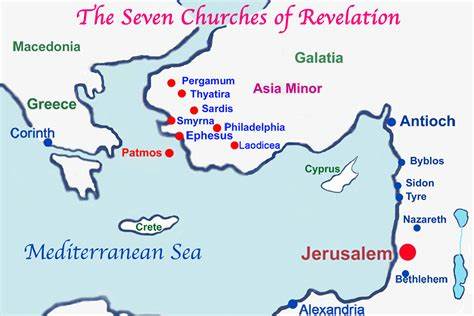
So what’s the significance of these churches? We’re told that some of them were small and weak. Many of them had allowed outside doctrine to muddy their waters. Several of them had allowed paganists into their midst. Only two of the churches did not receive any criticism (Smyrna & Philadelphia). In fact, we’ve seen the whole spectrum from disapprovals to approvals from Jesus in these letters. So again, is there significance in these particular churches?
Seven churches. Seven letters. And many believe there have been seven periods of the history of the church. This is a theory. Not everyone subscribes to this, but I do think it’s interesting and explains why these seven churches were addressed.
The theory is that the moral state of each of these churches lines up with periods or phases that have taken place in the body of Christ. The order of the letters to the churches lines up with the transformation timeline of the church and what has occurred since the crucifixion and resurrection of Jesus.
You’ll see that if we subscribe to this theory, we would currently be in the Modern Day church which is prophesied in the letter to the church at Laodicea.
Our final church is the church at Laodicea. The name Laodicea means “people ruling” or “judgment of the people”.
Here are a few things to know about Laodicea at the time John wrote this letter. Laodicea was experiencing an explosive boost in its economy. It served as the banking center of the region and, as a result, was considered a very wealthy area. In today’s environment, this would have been an area rich with fancy restaurants and high-end shopping. Laodicea was “known for its manufacture of a special eye salve, as well as of a glossy black wool cloth.”[i]
We’ve talked a bit about the great earthquake that took place in 17 AD. Whereas Philadelphia and other churches in that area were helped by the Roman emperors at that time with financial assistance and rebuilding efforts, Laodicea took care of themselves. They didn’t accept any aid or benefit from the outside; they were proud to be self-sufficient.

As good as things were in Laodicea, there was one area they weren’t so fortunate in. That was their water supply. They had to pipe in water from two different surrounding areas (Colossae and Hierapolis). Colassae’s water source was from the mountain snow and so it was very cold. Hierapolis got its water from hot springs in their area. By the time the two water sources met up in Laodicea, the water was tepid or lukewarm. The minerals that each water source had didn’t mix well and there was a strong mineral smell and taste to it as well. The bottom line: the Laodiceans didn’t have good water.
This is the beginning of the letter to them. Revelation 3:14 NIV “14 “To the angel of the church in Laodicea write:
These are the words of the Amen, the faithful and true witness, the ruler of God’s creation.”
All these descriptions used by Jesus are found in Revelation 1. Just like He had done with the previous six churches, Jesus identifies Himself in a way that is pertinent to the specific church He is addressing.
Amen. This is the only time in the New Testament that “’Amen’ is used as one of Christ’s official titles.”[ii] In Hebrew, the word “amen” means “so be it” but also Jews use it as an acronym for “Mighty, Faithful King.”[iii] The Greek meaning of “amen” is “truly” or “verily”.[iv]

Jesus is solidifying what He said in John 14:6, “I am the truth” as well as confirming His deity with God. When we end a prayer, what do we say? Amen. We say it to mean “so be it” or “truly”, but it’s also said as the last word in a prayer. Jesus, identifying Himself as the Amen is His way of saying “He is God’s last Word, there is no improving upon Him.”ii
This is the last letter in the letters to the church. In fact, after we finish with Chapter 3 today, there will be no further reference to the Church on earth. So it’s fitting that Jesus uses the multi-meaning term “the Amen”.
Jesus is also “the faithful and true witness”. This description mirrors the Amen reference in that Jesus is saying He is “God’s reliable witness, who never swerves from the truth.”[v]
Thirdly, Jesus identifies as the ruler or beginning of God’s creation. This substantiates John 1:3 HCSB “All things were created through Him, and apart from Him not one thing was created that has been created.”
All three descriptions would seem to indicate that the Laodiceans needed a reminder of the authority, genuineness, and sovereignty of Jesus.
This is what Jesus sees in them and this analogy would have been meaningful to the people in Laodicea because of their water supply. Revelation 3:15 GNT “15 I know what you have done; I know that you are neither cold nor hot. How I wish you were either one or the other! 16 But because you are lukewarm, neither hot nor cold, I am going to spit you out of my mouth!”
“There are three spiritual temperatures: a burning heart, on fire for God (Luke 24:32), a cold heart (Matt. 24:12), and a lukewarm heart (Rev. 3:16) The lukewarm Christian is comfortable, complacent, and does not realize his need. If he were cold, at least he would feel it!”i
We like to be comfortable, don’t we? We sometimes go to great lengths to make sure we’re comfortable. I’ve been spending a lot of time in hospitals lately and have a large tote bag I take with me each time. In it, I have all sorts of items to give me comfort and convenience. Heaven forbid that I should spend hours without a book, puzzles, or an inadequate charge on any of my electronic devices! But that’s quite indicative of not only our churches but our individual spiritual lives as well, isn’t it? We strive for and yearn for comfort for the most part. We certainly don’t pray for the thorn in our side but ask God to remove it.
We also don’t like conflict or confrontation when it comes to sinfulness and convictions. We don’t want to appear judgmental, so we mold, twist, and deform God’s Word to make everyone and their own doctrine acceptable. We certainly don’t like to be convicted of our own sinfulness and so we make excuses or find Scripture that justifies us. Or sometimes we’re just lazy and sing 87 verses of Just As I Am thinking that God’s going to be brainwashed into thinking that He just needs to accept us just the way we are and not have high expectations of us growing and maturing in His Word.

There’s a word for this mentality. Apathetic. It means “showing or feeling no interest, enthusiasm, or concern”. Now you may think that word doesn’t apply to you and it may not. Maybe you pray for our pastors and church leaders daily because you’re interested in their spiritual well-being and their obedience to God. Perhaps you fervently seek to please God each and every day with your words, your thoughts, and your actions because you’re enthusiastic about becoming more like Jesus. You may even pray for the people in our class, our church, or Bible study groups and genuinely love them and care for them. You might be one of the few who are eager to help out even if you won’t get any recognition because your concern is for the kingdom of God and not a pat on your back. Maybe your spiritual growth continues to mature and you’re not content unless you are growing.
But then again, maybe you’re like the majority of us who have periods of apathy in which we just want to be by ourselves, comfortable and unaware of the spiritual warfare that goes on all around us and our role in that. Perhaps you find yourself stuck in a routine, doing the same things the same way on the same days with the same attitude. Nothing new. Nothing challenging. There’s no refinement, no pruning, and no filtering. You’re neither a dried-up puddle in need of water nor a roaring ocean active and alive and feeding water into smaller bodies of water. Rather you’re just a stagnant pond; neither giving nor receiving, but simply existing.



This was the church at Laodicea. And I believe it very much describes the church today. We’ve lost our passion for Jesus. We’ve abandoned our fear of God. We’ve silenced the Holy Spirit so much that He grieves. Not everyone will agree with that belief because that would make us uncomfortable. When we are uncomfortable, we have to move or do something different to make ourselves comfortable.
But we don’t get that way overnight, do we? It’s a slow, steady decline. The church at Laodicea certainly didn’t start off being lukewarm. Perhaps they were passionate about Jesus and His teachings, but like the church at Ephesus, they lost their first love. Maybe they once held fast to Jesus’ name like their neighbors in Pergamos, but instead of Balaam becoming their idol, they allowed their wealth to take Jesus’ place. They may have been plentiful in their service to the ministry like the people of Thyatira, but they too were mesmerized by their own kind of Jezebel. Before they knew it, their church had lost its pulse much like the church of Sardis.
It’s like the analogy of the frog. “If a frog is put suddenly into boiling water, it will jump out, but if the frog is put in tepid water which is then brought to a boil slowly, it will not perceive the danger and will be cooked to death.”[vi]
We are not immune to becoming lukewarm in our relationship with Christ. Just like any healthy and growing relationship we have, we have to put forth effort, we must invest our time and attention. We must be willing to sacrifice ourselves and not take the relationship for granted. And we can’t allow others to get in the way or redefine that relationship so that we are more comfortable or content with a stagnant relationship with Jesus.
There was a pianist who had studied under a great teacher. He had practiced long and hard for his first concert. To his surprise, the auditorium was packed. He nervously played his first note and soon all of his hours of practice paid off and he ended the concert with a standing ovation from the crowd. “Encore!” they screamed over and over. As he bowed, he acknowledged each section of the auditorium as they continued to clap and cheer and demand an encore. All were on their feet, except one man who held his head in his hands. The pianist made his way offstage when he was stopped. “Where are you going?” he was asked. “The crowd wants more!” The pianist replied, “I can’t do it. There’s one who isn’t standing. He isn’t clapping or cheering.” “Look at that big crowd! Are you really going to let one man out of all of those people ruin this evening for you?” The pianist looked him in the eye and said, “You don’t understand. That man is my teacher.”
“The secret of the Christian’s passion is simple: Everything we do in life we do it as to the Lord and not to men.”
David Jeremiah
Others may look at us from the outside and think that our hearts are on fire for Jesus but only Jesus knows our spiritual temperature.
Revelation 3:17 NIV “17 You say, ‘I am rich; I have acquired wealth and do not need a thing.’ But you do not realize that you are wretched, pitiful, poor, blind and naked. 18 I counsel you to buy from me gold refined in the fire, so you can become rich; and white clothes to wear, so you can cover your shameful nakedness; and salve to put on your eyes, so you can see.”
Verse 17 is Jesus telling the church at Laodicea that they have fooled themselves. The church of Smyrna thought they were poor, but Jesus told them they were rich. Laodicea is just the opposite. Sure, they had monetary wealth and they had financial and material security, but they lacked what really mattered. Tony Evans said, “Here Jesus debunks a prominent lie of prosperity theology: being materially successful means God has blessed you. Not so.”[vii]
Jesus points out that, despite their claims, they were actually wretched (unhappy); they were pitiful (miserable); they were poor (lacking); they were blind (unaware); and they were naked (unguarded). You see they became satisfied with what they had and, as a result, deceived themselves into thinking they had all they needed.
It may be well with your family, your career, and your bank account, but is it well with your soul?
Jesus offers advice to the church at Laodicea. They need three things. “My advice is that you buy gold from me that has been purified by fire so that you may be rich, and white clothing to wear so that your nakedness won’t be shamefully exposed, and ointment to put on your eyes so that you may see.” (Revelation 3:18 CEB) The three things Jesus recommends to them are the very things they already have. These are the things they are known for. Wealth, garments, and a salve for the eyes.
The gold Jesus recommends is likely faith in Him. 1 Peter 1:7 ERV “7 These troubles test your faith and prove that it is pure. And such faith is worth more than gold. Gold can be proved to be pure by fire, but gold will ruin. When your faith is proven to be pure, the result will be praise and glory and honor when Jesus Christ comes.”
It’s a bit ironic that Jesus tells them that they are poor and naked; meaning they have nothing. But He tells them to buy gold from Him. If you’re poor and naked, you have nothing with which you can make a purchase. This obviously isn’t a monetary transaction; it’s a spiritual transaction. The original Greek word used for “buy” was agorasi which is defined as: “to buy, purchase; and to setting a slave free through purchase, often to God’s purchase (redemption) of sinners”.[viii] Jesus is advising the people of Laodicea to redeem their self-sufficiency and worthless wealth for a relationship with Him.
But notice that the faith (or gold as Jesus indicates) is purified by fire. That means persecution, struggles, and most likely being uncomfortable. It’s a good time to remember these were church people; they weren’t necessarily unsaved. These would have most likely been passionate Christ-followers at one point who had backslidden. Their lives were relatively easy; they may not have seen their need for a Savior. They prided themselves on their independence and their own resilience. We must be careful not to fall into that same trap. It’s easy to do. When life is going well and we’re not facing challenges or going through struggles, we tend to be the toddler that doesn’t want to hold a hand when they’re crossing the road. “I’ll do it myself.” “I can handle it.” We sing “I Need Thee Every Hour” but do we mean it? Jesus wants us to. Tim Keller said, “You don’t realize Jesus is all you need until Jesus is all you have.”

The second item Jesus recommends is white clothing. This is the complete opposite of the glossy black wool cloth that Laodicea was known for. The white clothing is representative of righteousness that only Jesus can give.
The third item is, again, ironic. Salve or ointment for the eye. This is Laodicea’s claim to fame in that region, but Jesus didn’t mean physical ailments of the eye. He meant spiritual ailments of the eye. They were blinded by their apathy and their sinfulness. He wanted them to be aware of their need for Him. For us, sometimes Jesus uses circumstances, struggles, and difficulties to cure us of our spiritual blindness. Life will often knock us off our feet and on our knees which is exactly where we should be.
Revelation 3:19 CEB “19 I correct and discipline those whom I love. So be earnest and change your hearts and lives. 20 Look! I’m standing at the door and knocking. If any hear my voice and open the door, I will come in to be with them, and will have dinner with them, and they will have dinner with me. 21 As for those who emerge victorious, I will allow them to sit with me on my throne, just as I emerged victorious and sat down with my Father on his throne. 22 If you can hear, listen to what the Spirit is saying to the churches.”
Jesus lovingly reminds them that He disciplines and corrects those that He loves and so He tells them to be zealous and repent. “His love is never so complacent that it condones sin in our lives.”ii
Verse 20 is often used when witnessing to non-believers, but remember, Jesus is addressing His church. If Jesus is standing at the door and knocking, that indicates He hasn’t been invited inside. Until I started this study, I didn’t envision Jesus knocking at a door in my life. I was saved on April 17, 1981, and I assumed I had opened the door and given Him the key. But you see, Jesus doesn’t want to have to use a key. Jesus wants to be inside that door every hour of every day.

We’re almost to the end of the letter and you may have noticed that Jesus has not commended them on anything. He knows their works, He knows their activities, their motives, their way of life and He has nothing positive to say. But has He abandoned them? No! Has He walked away from them? No! He’s standing at the door, knocking. He wants in. He knows that life, although it comes with heartaches and struggles, is infinitely better if He’s on the inside with us. Not only that but did you happen to notice what else He does on the outside of the door. He addresses anyone who hears His voice. That means that Jesus is saying something. Not only is He waiting on the outside knocking, but He’s also speaking to the individual on the other side of the door. Can you just imagine what Jesus says?
He promises that if anyone hears His voice and opens the door, He will enter and dine with that individual and they with Him. Sharing a meal with someone in Biblical times meant sharing your life with them. It was a lot more than Taco Tuesdays with friends or grabbing a sandwich with a co-worker. It was an intimate, relational experience. Isn’t it a sweet image of Jesus wanting to sit down and share a meal with you?
Verse 21 promises a reward far greater than the Laodiceans could acquire on their own. Listen carefully to this verse. “21 I will allow everyone who wins the victory to sit with me on my throne, as I have won the victory and have sat down with my Father on his throne.” (Revelation 3:21 GW) It would seem that Jesus is speaking of two different thrones. Not every commentator agrees on that. Personally, I don’t think Jesus would have made a distinction if it was just one throne. We’ll read further on in Revelation of other thrones, so I don’t think it’s impossible that Jesus is speaking of two different thrones. Here’s the one commentary that made the most sense to me.
“Here are two thrones mentioned. My throne, saith Christ: this is the condition of glorified saints who sit with Christ in His throne. “But My Father’s (i.e., God’s) throne is the power of divine majesty.” Herein none may sit but God, and the God-man Jesus Christ. The promise of sharing the throne is the climax of an ascending series of glorious promises, which carry the thought from the Garden of Eden (Revelation 2:7) through the wilderness (Revelation 2:17), the temple (Revelation 3:12), to the throne.”[ix]
I don’t believe we can know for certain until that day when it’s revealed to us.
The final sentence given to Laodicea is the same one that Jesus gave to every church. “He who has an ear, let him hear what the Spirit says to the churches.” (Revelation 3:22 NKJV)
The admonishments, criticisms, and corrective disciplines given to each church were broadcast to each of the seven churches. They were as pertinent then as they are now.
You may or may not choose to accept the theory that the moral state of the seven churches was prophetic of the moral state of church history and, as a result, we would now be considered as the lukewarm Laodiceans. That’s okay. You don’t need to be convinced of that. But what you do need to evaluate is your own spiritual temperate.
What water lines do you have coming into your life and are they mixed temperatures so that your spiritual life has become lukewarm? Do you have the hot water of daily study in God’s Word mixing in with the cold water of what you watch on television? Do you have the boiling water of earnestly praying for others with a genuine concern being cooled off by the coldness of engaging in gossip? Is the fiery passion of appreciation of what Jesus has done for you extinguished by the cold-hearted unforgiveness you just won’t let go of? It may be time to invite Jesus in to ignite the flame in every aspect of your life. Are you willing and ready to ask Him to turn up the heat?
“Lukewarm people don’t want to be saved from their sin; they only want to be saved from the penalty of their sin.” Francis Chan
[i] Be Victorious by Warren W. Wiersbe
[ii]Revelation by Lehman Strauss
[iii] What does “Amen” mean? – And where does the term come from? – Chabad.org
[iv]Strong’s Greek: 281. ἀμήν (amén) — truly (biblehub.com)
[v] What does Revelation 3:14 mean? | BibleRef.com
[vii]The Tony Evans Bible Commentary
[viii] ἀγοράζω | Free Online Greek Dictionary | billmounce.com
[ix] Revelation 3:21 Commentaries: ‘He who overcomes, I will grant to him to sit down with Me on My throne, as I also overcame and sat down with My Father on His throne. (biblehub.com) (Elliott)
 Beacons of Light