
“Blessed is he who reads and those who hear the words of this prophecy, and keep those things which are written in it; for the time is near.” (Revelation 1:3 NKJV)
Remember we are not expected to read and understand all of this. We aren’t here to break the code or solve the mystery of Revelation. Some of you may be extraordinarily intelligent, but I don’t think our ways and thoughts are anywhere close to God’s.
Over the next few months, we are going to be discussing things in Revelation that may be symbolic or they may be literal. We have to remember that John was writing these visions in approximately 95 A.D, so more than 1,900 years ago. The events that he was privileged to see in these visions will occur at some point in the future. Obviously, a lot has changed in those 1,900 years. Means of travel, technology, communication, just to name a few. We must keep in mind that John was given glimpses of prophecy but he may have had to use descriptions that he understood. I’ll give you an example.

In the 9th chapter of Revelation, John speaks of a swarm of locusts. He describes them as horses prepared for battle. He says they wear something like crowns of gold on their heads, and their faces look like human races. Their wings sound like the thundering of horses. Their tails have stingers like scorpions. If you were to draw out that description, you’d end up with something that looks a lot like our modern-day helicopters. Are the locusts really going to be helicopters? Who knows? We won’t have a clue until it occurs. But for our own way of thinking, we have to remember that John wouldn’t known about helicopters (in this example) and so his description of what he was seeing possibly isn’t to be taken literally.
Keep in mind as we study these future events that we aren’t going to know if what John writes is to be taken literally or symbolically.
In the beginning of this book, Jesus appears to John and one of the things He says to John is Revelation 1:19 NKJV “Write the things which you have seen, and the things which are, and the things which will take place after this.” From this, we deduce there are three periods of time that John is instructed to write about. We can assume that the “things John sees” are what he writes about in the first chapter of Revelation. This is where John sees the seven lampstands, holding the seven stars in His right hand.
The “things which are” presumably refers to the letters to the seven churches we covered in chapters 2 & 3. We know that these were real churches at that time who were addressed by Jesus in very specific ways.
That would leave us with the “things which will take place after this” period. And just so there’s no conjecture on our part, John seems to make it pretty clear in Revelation 4:1. “After these things I looked…” (NKJV)
In this chapter, John writes down what he sees taking place in the future. Not just his future, but our future as well. He’s just written the letters to the seven churches that were in existence in 95 A.D. What he writes about beginning in chapter 4 hasn’t taken place yet. If you believe, as I do, that the rapture will occur before the time of the tribulation period, then Revelation 4:1 takes place after what we read in 1 Thessalonians 4:16-18 CEV “ 16 With a loud command and with the shout of the chief angel and a blast of God’s trumpet, the Lord will return from heaven. Then those who had faith in Christ before they died will be raised to life. 17 Next, all of us who are still alive will be taken up into the clouds together with them to meet the Lord in the sky. From that time on we will all be with the Lord forever.”
Christ-followers will be in Heaven and what we will read about in chapter 4 takes place in Heaven. We are given a glimpse of what Heaven will look like at that point in time.
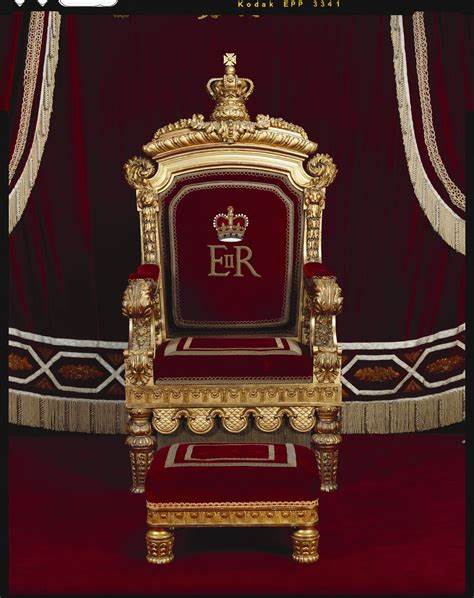
As we read through chapter 4 of Revelation, there’s a word that will be repeated many times. In fact, the same word is used 14 times in the NKJV. Other translations won’t share that number, but the word is still frequently used in all translations. The word is “throne”. A throne has always symbolized power and authority. It’s a sacred spot. Visitors to Westminster Abbey can’t sit in it and take selfies. No one but the reigning king or queen is allowed to sit in it. If you imagine how sacred King Charles’ throne is in England, imagine the majesty of God’s throne in Heaven!
It’s interesting to note that the book of Revelation mentions the throne in the first chapter (Rev. 1:4) and in the last chapter (Rev. 22:3). And all throughout the book, God’s throne is always at the center. Warren W. Wiersbe said, “No matter what may happen on earth, God is on His throne and is in complete control.”
Sometimes in today’s world, it may seem as if that’s not the case at all. We get distracted by the chaos and sinfulness of this world and we neglect to recognize God is still on the throne! As we will study in the next chapters about what will take place during the tribulation period, it’s important for us to remember where God is and the authority He always has.
Revelation 4:1 NKJV “After these things I looked, and behold, a door standing open in heaven. And the first voice which I heard was like a trumpet speaking with me, saying, “Come up here, and I will show you things which must take place after this.”
This is the 4th mention of a door in Revelation. The first instance was in the letter to Philadelphia where Jesus says, “See, I have set before you an open door, and no one can shut it”. This was referring to opportunities to witness and share the gospel. The second and third time Jesus refers to a door is in His letter to Laodicea where He speaks of standing at the door and knocking and if anyone hears His voice and opens the door, He will come in and eat with him. Of course, this was symbolic of Jesus speaking to believers asking them to let Him into every aspect of their hearts.
This time in Revelation 4, the image of an opened door is the invitation to John to enter into Heaven to see what Jesus wants to show him.
John hears a voice like a trumpet that invites him in to see the things that will take place. Trumpets were used throughout the Bible for different purposes. Sometimes they were sounded as a warning or an announcement of war. They were also used to call people together either for purposes of gathering or as an invitation at the beginning of special occasions. We’re going to see in Revelation that trumpets are used quite a lot and for different purposes then, as well.
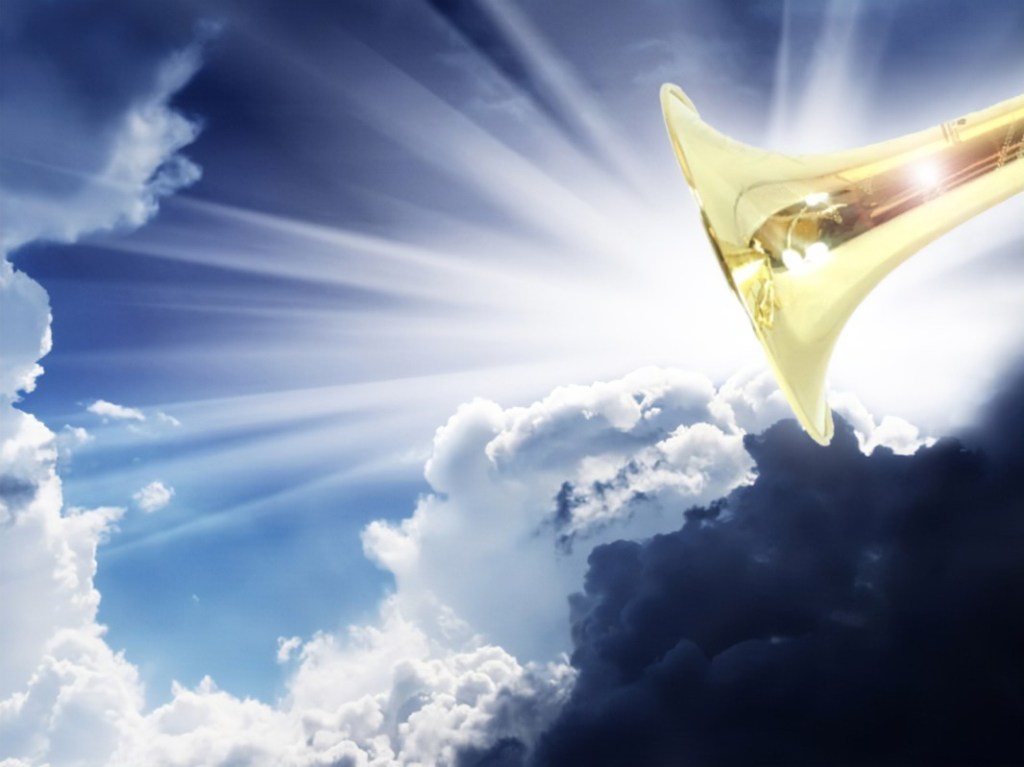
In this particular case, Jesus sounds like a trumpet used for inviting people to gather for a special occasion. Many Bible scholars suggest that what John experiences is possibly what we will experience one day. In chapters 2 & 3 John is writing to real churches at that time, and then, in a twinkling of an eye, John is experiencing Heaven.
Revelation 4:2 NIRV “2 At once the Holy Spirit gave me a vision. There in front of me was a throne in heaven with someone sitting on it. 3 The one who sat there shone like jasper and ruby. Around the throne was a rainbow shining like an emerald. 4 Twenty-four other thrones surrounded that throne. Twenty-four elders were sitting on them. The elders were dressed in white. They had gold crowns on their heads. 5 From the throne came flashes of lightning, rumblings and thunder. Seven lamps were blazing in front of the throne. These stand for the seven spirits of God.”
First and most importantly, John is in the Spirit. This affords him the ability to see things that otherwise he wouldn’t be able to see and the ability to comprehend things that otherwise he wouldn’t be able to comprehend. The good news for us is that the same Holy Spirit is the One who lives within us. If we submit ourselves to the Holy Spirit, can you just imagine ALL that He would show us and reveal to us? “But it was to us that God revealed these things by his Spirit. For his Spirit searches out everything and shows us God’s deep secrets.” (1 Corinthians 2:10 NLT)
What does John see?
- Throne with Someone sitting on it
- The Someone shone like jasper and ruby
- A rainbow shining like an emerald
- 24 other thrones that surrounded the main throne
- 24 elders sitting on the 24 thrones
- 24 elders were dressed in white and had gold crowns on their heads
- Lightning, thunder, and rumblings
- 7 lamps before the main throne
There’s no wrong answer here, but if you opened your eyes to this vision, what would be the first thing you see? The very first thing that catches John’s eye is the occupied throne. We can safely presume that it is God the Father Who is sitting there.
“We can’t think rightly about much of anything until we settle in our mind that there is an occupied throne in heaven, and the God of the Bible rules from the throne. “While there may be many differing interpretations, the fundamental truths are self-evident. At the center of everything is an occupied throne.” (Morgan)[i]
John uses gemstones to illustrate God’s appearance and the way John describes God is in a symbolic manner. He uses the phrase “like a jasper” meaning that God’s appearance is as brilliant as a precious stone. I would think, even being in the Spirit as John was at that time, there weren’t adequate words to describe what he was actually seeing. Ezekiel’s first vision is very similar to John’s vision. Ezekiel 1:28 AMP “As the appearance of the rainbow in the clouds on a rainy day, so was the appearance of the surrounding radiance. This was the appearance of the likeness of the glory and brilliance of the LORD. And when I saw it, I fell face downward and I heard a voice of One speaking.” Ezekiel also describes God’s surroundings in a comparison tone most likely because that was the closest description of anything we could comprehend. But you may have noticed that neither refer to the description of God Himself. It’s all about the brilliance and illumination around Him.
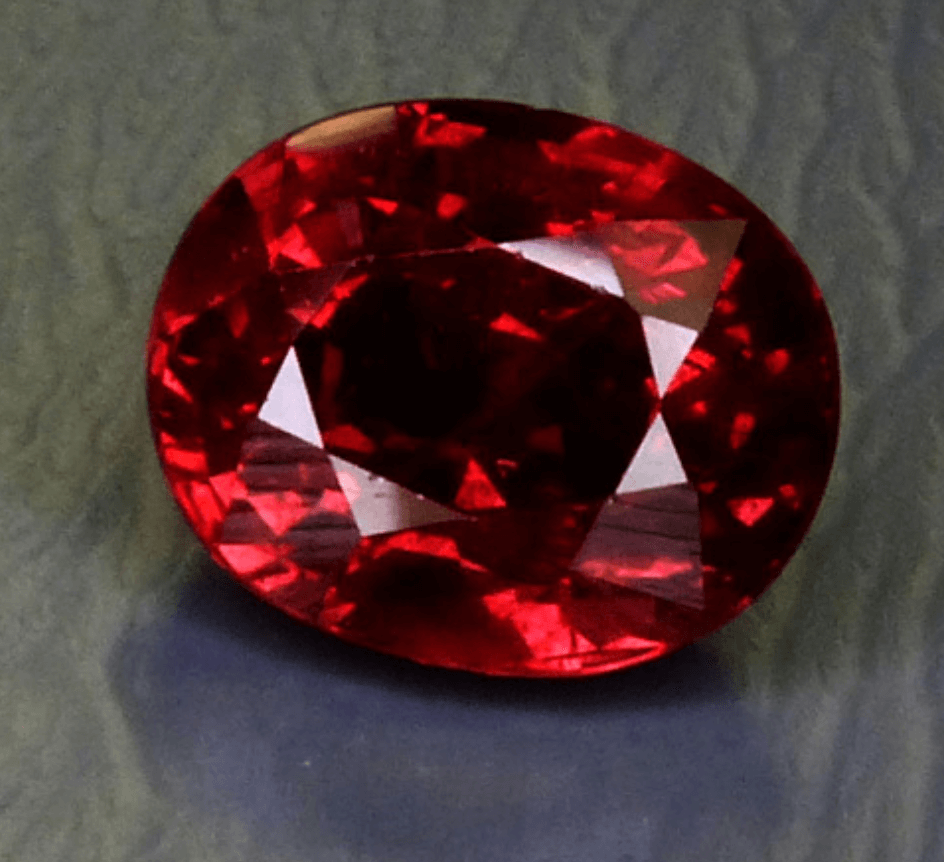
Jasper is the first stone mentioned. Carnelian, ruby, or sardius (depending on the translation) is the second stone mentioned.
The carnelian (or ruby or sardius) is universally thought to be a fiery red stone.[ii] The jasper, however, is more or less up for debate. Some believe that the jasper is a deep green; others believe that the jasper referred to here is another red stone. I tend to lean more toward the description given in Revelation 21:11 which describes jasper as crystal clear.
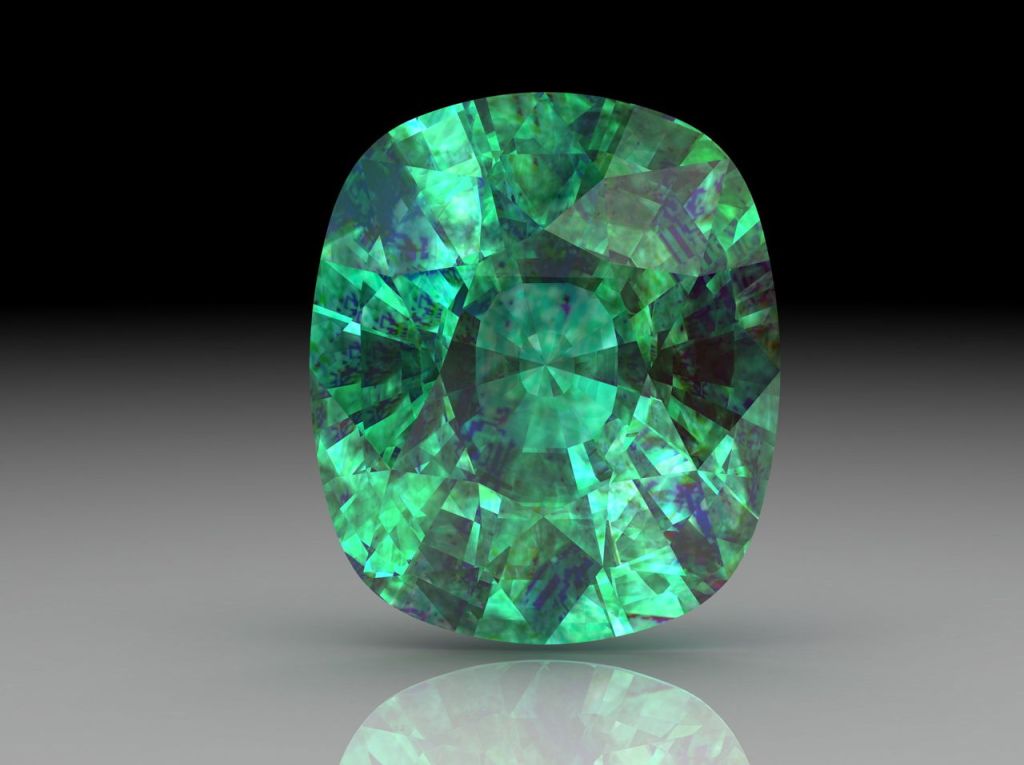
Add to that the emerald rainbow that is around the throne. The rainbow is symbolic of God’s covenant He made with Noah to never destroy the earth with a flood again. This wouldn’t be an arc of a rainbow as we normally see. Instead, this would be a full, unbroken circle surrounding the throne because nothing in Heaven is incomplete. The full rainbow would have been an indication of God’s fulfillment of that promise. “Judgment is about to fall, but the rainbow reminds us that God is merciful, even when He judges (Hab.3:2). Usually a rainbow appears after the storm, but here, we see it before the storm.”[iii]
Let’s talk about the stones themselves. I think most of us can agree that there is probably significance in the specific stones the Holy Spirit permits John to see. There are several possibilities of their meaning. One has to do with the colors of the stones.
“Jasper referred to God’s holiness, carnelian his wrath and judgment, and emerald referred to God’s grace and mercy.” [iv]

Another possible significance relates to the specific stones and the meaning is two-fold. For this, we look back to Exodus where the instructions for the priestly garments are given. Exodus 28:15 NKJV “You shall make the breastplate of judgment.” Skip down a few verses. “17 And you shall put settings of stones in it, four rows of stones: The first row shall be a sardius, a topaz, and an emerald; this shall be the first row; 18 the second row shall be a turquoise, a sapphire, and a diamond; 19 the third row, a jacinth, an agate, and an amethyst; 20 and the fourth row, a beryl, an onyx, and a jasper.” (Exodus 28: 17 NKJV)
The breastplate of judgment was worn by the high priest whenever he went before God. You may have noticed that the first stone mentioned is the sardius (or ruby or carnelian). The last stone is the jasper. On the breastplate of righteousness or the breastplate of judgment, the first and the last stones are what surround the throne. Let’s take that a step further. The instructions given in Exodus also mention inscribing the name of Jacob’s sons (indicating the twelve tribes) on the stones. Sardius, the first stone, represents the tribe of Reuben, the firstborn to Jacob. Jasper, represents the tribe of Benjamin, the last born of Jacob. Again, there’s a reference to the first and last. Alpha and Omega.
Reuben’s name means “behold a son”. Benjamin’s name means “son of my right hand”.
Factor in the rainbow resembling an emerald. Emerald was also used in the breastplate of judgment, and it represented the tribe of Levi. Levi’s name means “joined together” or “united”.
If we string those meanings together, it becomes, “Behold a son, son of my right hand, joined together” possibly referring to the joining of Jesus, God’s only Son, and the people for whom He died. Adding to the significance of the tribes represented is the idea of the special blessings that were given to each of those tribes. Reuben: Long life and growth. • Levi: Purity, faithfulness, and success. • Benjamin: Protection and favor.[v] Certainly all of these blessings would have been felt by John in this vision of Heaven.
One more thing about the colors that jumped out at me. When we see red, white, and green, we think of Christmas, right? Have you ever thought about why those colors are synonymous with Christmas? “The red represents the blood of Christ, symbolizing sacrifice and redemption, while green symbolizes eternal life and the hope brought by the birth of Jesus.”[vi] “ The color white is also associated with purity of Christ.”[vii] It’s only through Jesus’ sacrifice that we are redeemed and are made pure and, as a result, are able to experience eternal life.
Surrounding the throne, John sees 24 elders occupying 24 thrones. John sees them as being dressed in white with gold crowns on their heads. Who are these elders? Let’s start with the number of them first. 24. The number 24 in a Biblical sense is associated with priesthood.[viii] In 1 Chronicles, when King David appoints 24 elders to represent the entire Levitical priesthood. Each of these served alongside many other priests. “The priests were many thousands in number.” Ix Each lot served for a two-week period in the temple. “They could not all come together at one time, but when the twenty-four elders met in the temple precincts in Jerusalem, the whole priestly house was represented.”[ix] That’s one explanation of the number of 24.
Another theory is that 24 represents the sum of the 12 tribes of Israel in the OT and the 12 apostles from the NT.
But who will these elders be? Truthfully, no one knows, nor do we know who they represent. Warren W. Wiersbe said “These elders probably symbolize the people of God in heaven, enthroned and rewarded.” The white clothing tells us of their righteousness; the gold crowns could indicate authority, royalty or victory. Since there are different types of crowns to be issued in Heaven, we don’t necessarily know.
1. The crown of life James 1:12
2. The crown of righteousness 2 Timothy 4
3. The crown of glory 1 Peter 5:4
4. The crown of victory appears 1 Corinthians 9:24-27
5. The crown of joy 1 Thessalonians 2:19
We’ll see further on in scripture a part of what these 24 elders do.


Verse 5 tells us what comes from the throne. We are going to see a lot of weather and nature-related occurrences. Here John witnesses flashes of lightning, thunderings, and voices proceeding from the throne. “These are indications of a coming storm and reminders of God’s awesome power.”iii Whereas God currently sits on a throne of grace, we are going to see God’s throne of judgment and wrath.
The last thing we’ll talk about today will be the seven lamps of fire that are before the throne. This one is easier because Scripture tells us these are the seven Spirits of God. We talked about this in chapter 1 of Revelation. The greeting John receives is from “Him who is and who was and who is to come, and from the seven Spirits who are before His throne.” The seven spirits of God seem to reference Isaiah 11:2 CSB “The Spirit of the LORD will rest on him — a Spirit of wisdom and understanding, a Spirit of counsel and strength, a Spirit of knowledge and of the fear of the LORD.” This would symbolize the completeness and perfection of the Holy Spirit.
If you think back to what John sees and experiences, everything focuses on the throne. It’s either Who is on the throne, what is around the throne, who is around the throne, what comes from the throne, and what is before the throne. How much better would our perspective be if we focused more on Who is on the throne and what comes from the throne?
[i] Enduring Word Bible Commentary Revelation Chapter 4
[ii] Revelation 4:3 Commentaries: And He who was sitting was like a jasper stone and a sardius in appearance; and there was a rainbow around the throne, like an emerald in appearance. (biblehub.com)
[iii] Be Victorious by Warren W. Wiersbe
[iv] The Stones in the Throne Room in Revelation 4 – Reading Acts
[v] Deuteronomy 33 Chapter Summary (biblehub.com)
[vi] Why Are Red And Green The Color Of Christmas? – Mental Scoop
[vii] https://www.colorwithleo.com/why-are-the-christmas-colors-red-green-and-white/
[viii] https://www.biblestudy.org/bibleref/meaning-of-numbers-in-bible/24.html
[ix] Revelation by Lehman Strauss
 Beacons of Light