Last week we learned more about the Antichrist and the false prophet. We discussed their authority, power, and the threatening way they will obtain followers. After such a dismal chapter of doom and gloom, God, in His mercy, gives us another refreshing and encouraging commercial break in chapter 14. Let me start off by reminding you that some chapters in Revelation are not in chronological order. This is one of them. Instead, this chapter reads more like a highlight reel.
John has seven visions in this chapter alone.
Revelation 14:1 NIV “14 Then I looked, and there before me was the Lamb, standing on Mount Zion, and with him 144,000 who had his name and his Father’s name written on their foreheads. 2 And I heard a sound from heaven like the roar of rushing waters and like a loud peal of thunder. The sound I heard was like that of harpists playing their harps. 3 And they sang a new song before the throne and before the four living creatures and the elders. No one could learn the song except the 144,000 who had been redeemed from the earth. 4 These are those who did not defile themselves with women, for they remained virgins. They follow the Lamb wherever he goes. They were purchased from among mankind and offered as first fruits to God and the Lamb. 5 No lie was found in their mouths; they are blameless.”
John first sees the Lamb, who we know to be Jesus, standing on Mt. Zion. There are two Mt. Zions and, of course, two different opinions on which this is. Mt. Zion on earth is located in Jerusalem. Mt. Zion, as referred to in Hebrews 12:22, is in the heavenly Jerusalem. So, which Mt. Zion is John seeing?
Warren Wiersbe says, “I personally believe that this is the heavenly Mount Zion, and that the scene anticipates Christ’s coronation and the establishment of His kingdom when he returns to earth (Zech. 14:4).”[i]
Lehman Strauss, however, has a different opinion. “This is an earthly scene, a picture of Christ’s return to reign, the selected place from which He shall rule gloriously.”[ii]
What we do know for sure is that the 144,000 from Revelation 7 are with Him. These represent the 12 tribes of Judah (minus the tribe of Dan) so we know these are Jews. Verses 4 & 5 give us a little more insight as to what sets them apart.

They are described as having “not defiled themselves with women” and they are called virgins. The original Greek words used here mean “not soiled” and “chaste”. Automatically, we think of this as referring to sexual purity, which it certainly could be the case. But undefiled and chaste could also reference their freedom from pagan influences and speak to their totally moral purity and their total allegiance to Jesus.
They follow the Lamb wherever He goes meaning they depend on Him for their assignments. Their lives are His. “…they follow the conduct of his word, Spirit, and providence, leaving it to him to lead them into what duties and difficulties he pleases.”[iii] We think it’s difficult to do that now. Can you imagine how it will be for them during the days of the Tribulation? To follow Christ will certainly be the most difficult path in those days.
They are described as being “firstfruits” which “means the ‘very finest’”.[iv] It also means that there’s an expectation of more to be harvested. And then verse 5 classifies them as blameless. They weren’t sinless, but they were blameless because of the blood of Christ Jesus. Jude 24 states the same about us.
Jude 1:24 CEB “To the one who is able to protect you from falling,
and to present you blameless and rejoicing before his glorious presence,
25 to the only God our savior, through Jesus Christ our Lord,
belong glory, majesty, power, and authority,
before all time, now and forever. Amen.”

Back in verse 3 we are told that the 144,000 sing a new song and it’s a song that no one else can sing. Why do you suppose that is? Their experience will be like no other. They will endure persecution but also protection. They’ll see unprecedented evil while they practice unprecedented evangelism. This will be a victory song stemming from the complete redemption of the church and this victory will be even more significant to the 144,000 who experienced the war firsthand on the battlefield.
John is then given another vision.
Revelation 14:6 NIV “6 Then I saw another angel flying in midair, and he had the eternal gospel to proclaim to those who live on the earth—to every nation, tribe, language and people. 7 He said in a loud voice, “Fear God and give him glory, because the hour of his judgment has come. Worship him who made the heavens, the earth, the sea and the springs of water.”
This is the first of several angels that John will see. Each angel has their own message to declare. The first angel is sent out to invite people to worship God the Creator because that door for salvation is closing. There will come a time when the invitation is no longer extended. This scene is unique because of the chosen messenger. “During the present age, the angels are not privileged to preach the gospel.”[v] That privilege belongs to us.
I’ve heard throughout my life that Jesus will not rapture us until His gospel has reached every nation. Perhaps you’ve been taught the same thing. The picture that’s painted in this thought is that God is patiently tapping His foot waiting on us to do just that until He gives Jesus the go ahead. This is based on Matthew 24:14 CEV when Jesus said, “When the good news about the kingdom has been preached all over the world and told to all nations, the end will come.”
Many Biblical scholars believe that “the end” refers to the end of the Tribulation and not the Rapture of the church. During the Tribulation, God will commission the 144,000 to spread the Gospel. He will station the two witnesses who will be immortal until their assignment is completed and then He will resurrect them in front of the entire world. And now, this Gospel Angel, we are told, will fly in mid-air to reach every nation, tribe, language, and people. Before the end of the Tribulation, there will be no one who hasn’t heard the Gospel. Is this, perhaps, what Jesus meant? Truthfully, I don’t think anyone knows for sure. It certainly shouldn’t cause us to be ambivalent about going out into the mission field. We should be diligent in our support of and participation in spreading the Gospel to every nook and cranny of the Earth.
“By offering repeated opportunities for repentance, and extraordinary evidence of His truth, God is removing all excuses. These events, in part, help to prove that humanity does not ultimately reject God because they are misled, or uninformed. Mankind rejects God because they love their sin more than their Creator.”[vi]
John then sees a second angel. Revelation 14:8 NIV “8 A second angel followed and said, “‘Fallen! Fallen is Babylon the Great,’ which made all the nations drink the maddening wine of her adulteries.”
What is Babylon the Great? It’s the worldwide kingdom whose mission is to oppose God and support Satan through the Antichrist.
“This proclamation anticipates the events of Revelation 18 (see also Rev. 16:18-19).”[vii] The message of the second angel is that of the doom of the system of the Antichrist as Babylon is often used as a symbol of evil and defilement. Jeremiah 51 spoke of Babylon and its influence on the world. “Babylon was like a golden cup in the Lord’s hand.
Babylon made the whole world drunk.
The nations drank Babylon’s wine,
so they went crazy.” (Jeremiah 51:7 ERV)
“Babylon holds several theological themes in the Bible. It is often associated with wickedness, idolatry, and rebellion against God.”[viii]
The ways of the Antichrist (and, of course, Satan) can intoxicate people with the darkness of this world. The second angel makes the declaration that Babylon (aka the Antichrist) will be defeated!
Following is a third angel who brings a message of condemnation to those who choose the beast. Revelation 14:9 NIV “9 A third angel followed them and said in a loud voice: “If anyone worships the beast and its image and receives its mark on their forehead or on their hand, 10 they, too, will drink the wine of God’s fury, which has been poured full strength into the cup of his wrath. They will be tormented with burning sulfur in the presence of the holy angels and of the Lamb. 11 And the smoke of their torment will rise for ever and ever. There will be no rest day or night for those who worship the beast and its image, or for anyone who receives the mark of its name.”
So much harshness in these verses! Fury. Wrath. Tormented with burning sulfur. Smoke of their torment for ever and ever. No rest day or night.
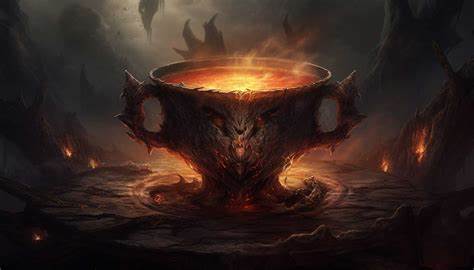
In verse 10, there’s mention of the cup of God’s wrath. This image is used multiple times throughout the Bible. One example is Psalm 75:8 GNT “The LORD holds a cup in his hand, filled with the strong wine of his anger. He pours it out, and all the wicked drink it; they drink it down to the last drop.” The insinuation is that God makes those under judgment drink His wrath. Jesus, in His last hours prayed, “My Father, if it is possible, let this cup pass from Me; yet not as I will, but as You will.” (Matthew 26:39) Jesus knew how bitter the wrath was going to be and it stands to reason that the human side didn’t want to experience it; however, His willingness to submit to God’s will is made in the same breath as His desire to escape the wrath.
At this point in the Tribulation, each person must make a decision. They either serve God and refuse the mark of the beast or they take what seems to be the easy route and worship the beast. Those who choose the beast will have the cup of wrath forced upon them.

John is then given another image.
Revelation 14:14 NIV “14 I looked, and there before me was a white cloud, and seated on the cloud was one like a son of man with a crown of gold on his head and a sharp sickle in his hand. 15 Then another angel came out of the temple and called in a loud voice to him who was sitting on the cloud, “Take your sickle and reap, because the time to reap has come, for the harvest of the earth is ripe.” 16 So he who was seated on the cloud swung his sickle over the earth, and the earth was harvested.
17 Another angel came out of the temple in heaven, and he too had a sharp sickle. 18 Still another angel, who had charge of the fire, came from the altar and called in a loud voice to him who had the sharp sickle, “Take your sharp sickle and gather the clusters of grapes from the earth’s vine, because its grapes are ripe.” 19 The angel swung his sickle on the earth, gathered its grapes and threw them into the great winepress of God’s wrath. 20 They were trampled in the winepress outside the city, and blood flowed out of the press, rising as high as the horses’ bridles for a distance of 1,600 stadia.”
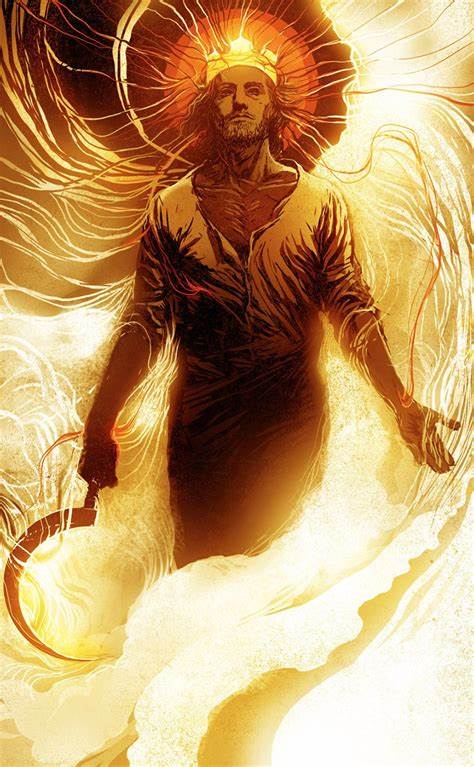
The Son of man is Jesus. He’s sitting on a white cloud symbolizing purity. He’s wearing a golden crown indicating victory and He is holding a sharp sickle which means judgment. Jesus will be joined by three separate angels.
The first angel emerges from the temple and tells Jesus it’s time to harvest the earth because the harvest is ripe. We tend to think of harvesting as collecting the good and useful stuff and separating it from the weeds. This is just the opposite. “This is a judgment scene. The Judge is about to sweep the earth clean of all evil.” “The harvest here is not the gathering of the good wheat into His garner as in Luke 3:17, but rather that tares which are the children of the wicked one as in Matthew 13:38-42. There is a harvest of evil as well as harvest of good (cf. Proverbs 13:21; Luke 3:17; Galatians 6:7).[ix]
Jesus does just that. He swings His sharp sickle, meaning that the judgment is quick and thorough, and evil is harvested.
“Another angel emerges from the temple in heaven, which suggests he has full authority from God for what he is about to do. He, too, carries a sickle. This sickle, like the first, will be used to “harvest” unbelievers. The symbolism of reaping and harvesting describes God’s eventual destruction of all non-believers during the end times. Unlike most of Revelation, the segment contained in chapters 12 through 15 jumps back and forth in time, with this passage looking ahead to the end of the tribulation.”[x]
Then John witnesses another angel. This angel, we are told, controls the fire and comes from the altar. This angel calls out to the angel with the sickle and tells him to use the sickle to harvest grapes from the earth’s vine that are fully ripe. The angel with the sickle does just that and throws the mature grapes into the winepress of God’s wrath. As a result, a bloody river flows.
There’s a good bit of symbolism in this image.
Listen to Joel 3:13 NIV. “Swing the sickle,
for the harvest is ripe.
Come, trample the grapes,
for the winepress is full
and the vats overflow—
so great is their wickedness!”

Several times throughout Scripture, Israel is compared to a vine. They were a vine intended to bear fruit for God, but failed time and time again. In the New Testament, we are introduced to the idea of Jesus being the vine and believers being the branches. The harvesting of grapes that takes place here in Revelation are those who are attached to the earth’s vine created by Satan and seen through the Antichrist.
The grapes (or unbelievers) will be crushed in the winepress located outside of the city, presumably meaning outside of Jerusalem. This would be most appropriate because it was outside the city of Jerusalem that Jesus took on God’s wrath on our behalf.
Remember, this is not chronological, and we seem to be given a glimpse of the end of the Tribulation. Therefore, it’s commonly believed that this is describing the Battle of Armageddon, the catastrophic battle that takes place between good and evil towards the end of the Tribulation.
The amount of blood that Scripture tells us flows from the winepress is unimaginable. If we take this literally, we’d be looking at a river of that runs 180 miles long and 5 to 6 feet deep. Some suggest that the battle is so violent that blood is just splattered as high as the bridle of a horse. Either way, it will be gruesome. We’ll read in Revelation 19 that Jesus wears a robe dipped in blood. It’s not His blood, but rather the blood of His enemies.
As grapes are crushed and broken to release wine, the bodies of God’s enemies will be smashed in a bloody defeat. Taken in absolutely literal terms, this verse describes a cascade of blood some five or six feet (2 meters) high and 180 miles (290 kilometers) long. Most interpreters see this as primarily symbolic. Some suggest that what’s described is a 1600-stadia zone of carnage during battle, so violent that blood is splattered as high as the head of a horse.
Listen to Isaiah 63:1b TLB “Who is this in royal robes, marching in the greatness of his strength?
“It is I, the Lord, announcing your salvation; I, the Lord, the one who is mighty to save!”
2 “Why are your clothes so red, as from treading out the grapes?”
3 “I have trodden the winepress alone. No one was there to help me. In my wrath I have trodden my enemies like grapes. In my fury I trampled my foes. It is their blood you see upon my clothes. 4 For the time has come for me to avenge my people, to redeem them from the hands of their oppressors.”
Jesus, in all of His glory, authority, and power, will trample the enemies like grapes. Victory is His, and as followers of Him, victory is ours.
In closing, there’s a verse we skipped over that speak to us and about us.
Revelation 14:12 NIV “12 This calls for patient endurance on the part of the people of God who keep his commands and remain faithful to Jesus.
Patient endurance. Yikes. Anyone else have a little trouble with that? Some of us just struggle with the patient part; forget the endurance aspect of it!

Hebrews 12:1 GNT tells us, “As for us, we have this large crowd of witnesses around us. So then, let us rid ourselves of everything that gets in the way, and of the sin which holds on to us so tightly, and let us run with determination the race that lies before us.”
Some days, it’s all we can do to get up out of bed, much less participate in any kind of race. But we are summoned by God to run with determination the race that He puts before us. “The word race is from the Greek agon, from which we get the word agony. The Christian’s race is not a jog but rather a demanding and grueling, sometimes agonizing race. It takes a massive effort to finish strong.”[xi]
In the final days, it’s just going to be a lot easier to give into the evil side. Life will be difficult for everyone, but it’s going to be brutal and potentially deadly for those who choose God. They will face persecution that we cannot even fathom, but they’ll do it out of their love, faithfulness, and thankfulness to God.

Even today, sometimes it’s just easier to give in to temptation, to take the easy route, and to not fight against our human nature. But that’s not patient endurance. That’s not relying on help from the Lord, the Maker of Heaven and earth. That’s selfishness, that’s laziness, and that’s sinful. God has never promised a rose-filled garden for our time on our Earth. We are subject to suffering, hardships, uncertainties, and all means of heartache. But “What God does promise, as we see in passages like this in Revelation, is that our patient endurance will be worth it. There is going to be a time of judgment – in which God will right the wrongs in our world – and we need to keep that in mind as we go about our lives.”[xii]
“You don’t have to understand everything to trust God with every thing.” (Unknown)
[i] Be Victorious by Warren W. Wiersbe
[ii] Revelation by Lehman Strauss
[iii] Revelation 14 Commentary – Matthew Henry Commentary on the Whole Bible (Complete) (biblestudytools.com)
[iv] Be Victorious by Warren W. Wiersbe
[v] Be Victorious by Warren W. Wiersbe
[vi] What does Revelation 14:6 mean? | BibleRef.com
[vii] Be Victorious by Warren W. Wiersbe
[viii] Exploring the Significance of Babylon in the Bible (biblicaldefinitions.com)
[ix] Revelation by Lehman Strauss
[x] What does Revelation 14:17 mean? | BibleRef.com
[xi][xi] Life Lessons from Revelation by Max Lucado
[xii] Life Lessons from Revelation by Max Lucado
 Beacons of Light