
Take a look at Matthew 5 through Matthew 7.
Matthew 5:1-2a NIV “Now when Jesus saw the crowds, he went up on a mountainside and sat down. His disciples came to him, 2 and he began to teach them.”
Matthew 7:28 NIV “28 When Jesus had finished saying these things, the crowds were amazed at his teaching, 29 because he taught as one who had authority, and not as their teachers of the law.”
These two verses serve as the bookends to the Sermon on the Mount. Every verse in between these two verses comprises the longest sermon of Jesus that has been documented for us.
Jesus spoke with purpose and clarity, maintaining a coherent sequence of topics. It is reasonable to assume that His choice of outline and the order of subjects was intentional. Keeping that in mind, consider this.
The Sermon on the Mount has three parts: Kingdom Identity (Matthew 5:3-16) which includes the Beatitudes, and the scripture regarding being salt of the earth and a light of the world. A Greater Righteousness (Matthew 5:17 – Matthew 7:12) in which multiple subject matters are covered including murder, divorce, adultery, judging others, etc.). The third part is all about The Choice (Matthew 7:13-27) and this is where Jesus talks about the wide and narrow gates, and the houses built on different foundations.
The center part (Greater Righteousness) has three parts: Torah & Prophets (Matthew 5:17-48), Religious Practices (Matthew 6:1-21), and Right Relationships (Matthew 6:19-Matthew 7:12).
The section covering Religious Practices also has three parts: True Reward (Matthew 6:1), True Devotion (Matthew 6:2-18) & True Wealth (Matthew 6:19-21).
True Devotion also has three parts: Generosity (Matthew 6:1-4), Prayer (Matthew 6:5-14), and Fasting (Matthew 6:16-18).
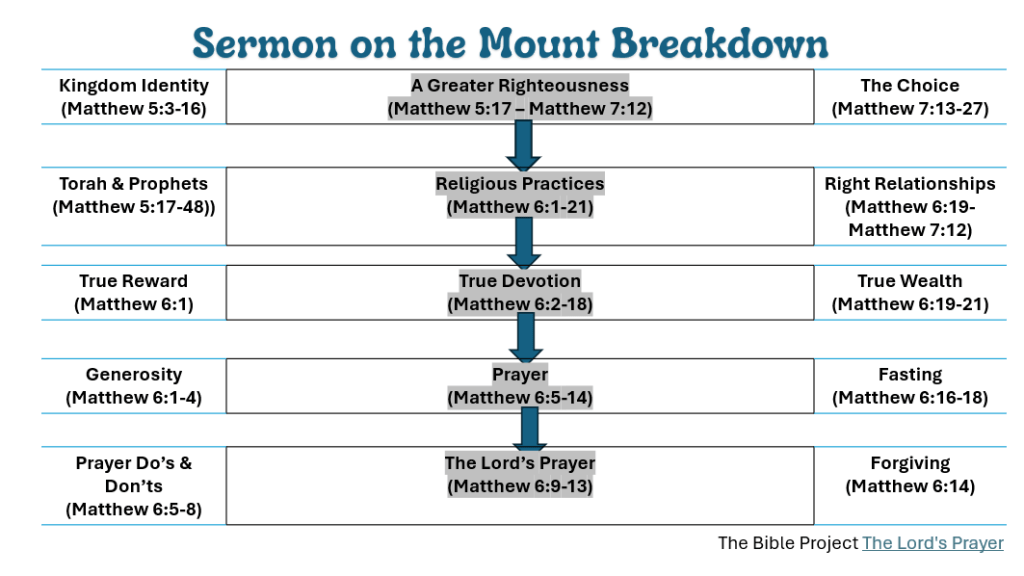
So, in the center of the center of the center of the center of the center of the center (that’s 6 centers!) of the Sermon on the Mount is our verse for today.
One thing to notice right from the start is the transition that takes place from verses 9 & 10 to verse 11. Your name, Your kingdom, Your will to give us our daily bread. The focus shifts from God to our needs.
We’ve discussed the fact that we can be a bit jaded or lackadaisical when it comes to the Lord’s Prayer. It’s something we learned decades ago and we have become accustomed to reciting it without much thought or emotion.
But take a good look at The Lord’s Prayer in Matthew 6. We go from hallowing God’s name, requesting His kingdom and His will to be made alive in us, to asking forgiveness in tandem with how we forgive others, requesting protection from temptation and evil. And nestled right in the center of these things of great magnitude is what? A plea for daily bread.
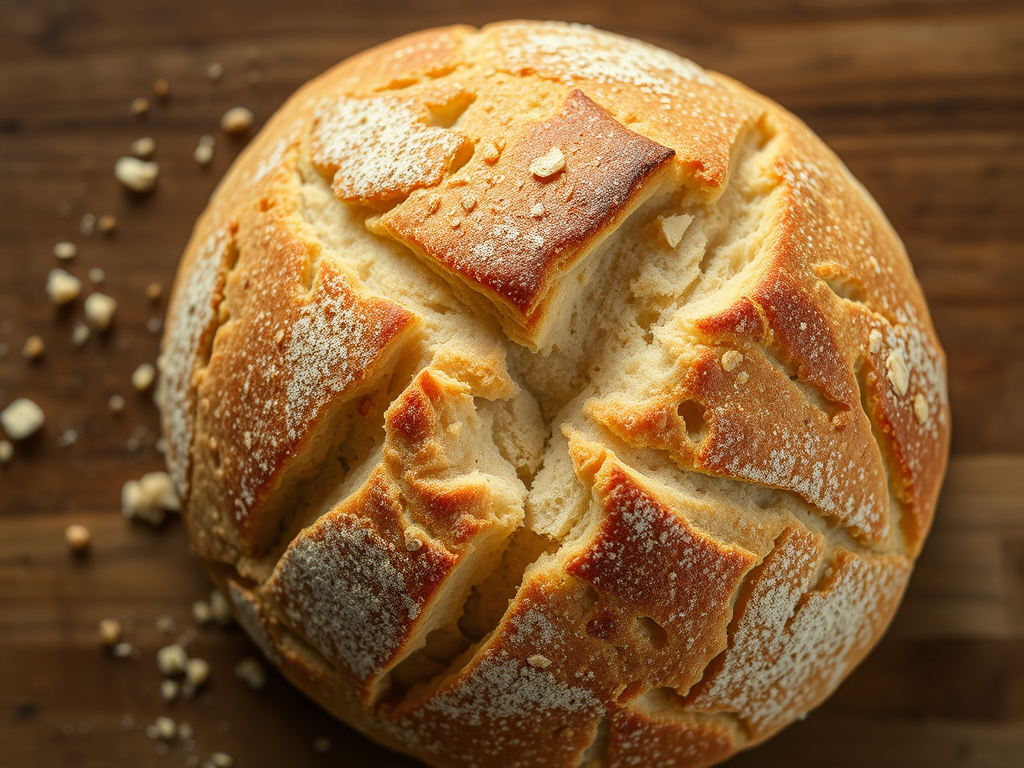
“Does it not seem strange that in the very center of this great prayer, our Lord should suddenly switch the emphasis from something as majestic as the will of God to a subject as earthy as bread?”[ii]
When you read about daily bread in Matthew 6:11, what image comes to mind? I think of a famous early 1900s photograph called Grace by Eric Enstrom, often seen on our grandparents’ walls.
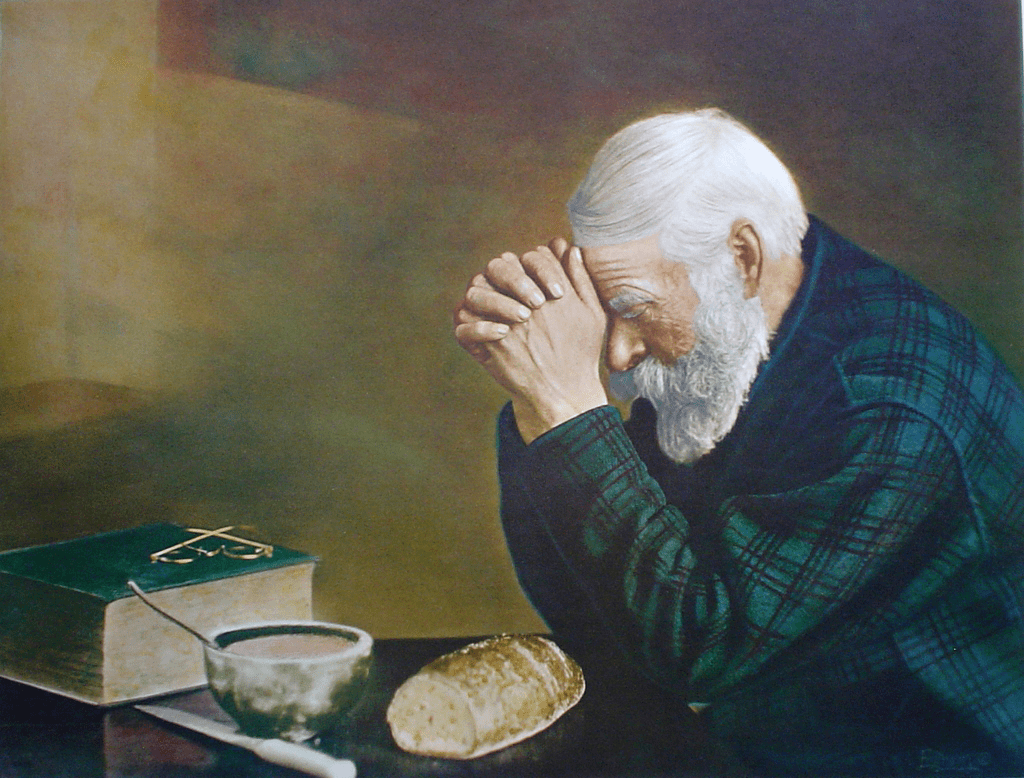
Some may jump to the idea of God’s Word being our daily bread which is feasible.
Others may consider Jesus as the Bread of Life, our daily bread. Again, that makes good sense.
Most likely, you think of daily bread as a reference to manna and that’s the avenue we’ll concentrate on for today.
Here’s a recap as to how the Israelites were introduced to manna.

The Israelites were enslaved by the Egyptians. After multiple unsuccessful pleas by Moses to Pharoah for their release, and after witnessing 10 plagues that affected everyone around them, but from which they were protected, the Israelites find themselves freed from capture and following Moses on a journey to the Promised Land. But, as we know, Pharoah changes his mind, and goes after them as they stand before the Red Sea. The Israelites, by all accounts, were trapped. The Red Sea before them, their captors behind them. But Moses stretches out his hand, and God splits the waters, dries up the sand, and makes a safe passageway for the Israelites to cross. When the last Israelites were safely ashore on the other side, God caused the Egyptians who were chasing them to become confused and panicked. He caused their chariots to become difficult to drive. And He told Moses to stretch his hand back out so that the waters would swallow up the enemies of the Israelites. (Exodus 14)
And as a result, Exodus 15 has the Israelites singing praises to God. “Lord, who is like you among the gods?
Who is like you, glorious in holiness,
revered with praises, performing wonders?” (Exodus 15:11 CSB)
Three days later, the complaints started coming in. “The people grumbled to Moses, “What are we going to drink?” (Exodus 15:24 CSB) because the water was bitter. The Lord showed a tree to Moses. Moses throws the tree into the river and the water becomes drinkable. They asked and the Lord answered.
A few weeks later, the grumbling starts again. And this time, it’s a little more dramatic. “2 There in the desert they started complaining to Moses and Aaron, 3 “We wish the Lord had killed us in Egypt. When we lived there, we could at least sit down and eat all the bread and meat we wanted. But you have brought us out here into this desert, where we are going to starve.” (Exodus 16:2 CEV)
Considering all the good they had witnessed and experienced, we can’t help but see the Israelites as a bunch of whiny brats at this point. It seems a bit ungrateful for them to be complaining and wishing that they had died while in captivity rather than starve in freedom, doesn’t it? But the truth of the situation is that they were hungry. They were lacking a basic necessity.
Did God know they were hungry? Of course, He did!
Did God care they were hungry? Most certainly!
Was God capable of fixing their hunger? Without a doubt!
So why then, did God allow them to get to this point? The Israelites probably wondered that as well. But Moses answers that for them in Deuteronomy 8:2 EASY “2 Remember how the Lord your God led you all the way across the desert. He took care of you for 40 years. He caused many troubles to come and to test you. He did that to see if you would trust him. He wanted to know whether you would continue to obey his commands. 3 He caused you to become hungry and then he fed you with manna.[a] Neither you nor your ancestors had ever seen this food before. In this way, he taught you that food alone cannot cause people to live. They need to hear every word that the Lord speaks. That is what gives them true life.”
You see, God caused troubles to come their way to see if they would trust Him. And He caused them to be hungry so that He could feed them with something that was unknown to them. He provided them with just enough for that day. If they took more than they needed, it would spoil. If they didn’t go out and gather what God had provided, they stayed hungry.
What God was teaching the Israelites was a basic, fundamental truth that, quite frankly, we forget. He was giving them a literal life lesson to be God-reliant and not self-reliant. God put the Israelites in a situation in which they depended on Him day-to-day to provide for their needs.

I’m sure most of us have experienced lean times. Do any of you know what it’s like to go grocery shopping with a calculator in your hand? I do. For many years, I never went shopping without keeping a running tally of what was in my buggy. I mastered it after a bit in that I would go through the grocery store and get what was absolutely needed, keeping a running total, of course. And then, if I had some extra, I’d go back through the store and pick up those things that weren’t top priority.
Despite the lean years, I can honestly say that my cabinets have never been empty. We may not have had what we wanted to eat, but we never went hungry. I’ve never wondered where my next meal was coming from and I would think most of you haven’t either.
Let’s be real. Most of us have never known what it is like to depend on God for food. We may buy store brands or get food from co-ops, or maybe your mom sends leftovers home with you like my mom used to do. But to have bare pantries or refrigerators? That’s just not an experience most of us can relate to. Our prayers regarding food include blessing it and praying that God keeps us from eating that second piece of cheesecake.
That self-reliance extends way beyond food for us, though, doesn’t it?
We sometimes don’t have a clue as to how self-reliant we’ve become until something goes wrong and the hunger pangs begin. (And I’m not referring to a hunger from lack of food.) Our self-reliance is just as natural to us as blinking and breathing. We don’t have to think about it; it just happens naturally.
We pay our bills, set our schedules, and go about our lives. We have relationships and we interact with others. And the self-reliance train keeps chugging along until….there isn’t enough money to pay our bills, our schedules are hectic and overwhelm us and our lives feel unfulfilled. When our relationships become fractured and our interactions with others end in conflict, hurtfulness, and emptiness. And nothing seems to be going right.
Those are like the hunger pangs that God caused the Israelites to experience. He knew that it took discomfort and that gnawing feeling for the Israelites to turn to Him and trust Him to provide their daily bread. God will, at times, put us in positions to where we have pangs for hunger for Him.
Jeremiah 17:5 ICB “This is what the Lord says:
“A curse will be placed on those who trust other people.
It will happen to those who depend on people for strength.
Those are the ones who have stopped trusting the Lord.
6 They are like a bush in a desert.
It grows in a land where no one lives.
It is in a hot and dry land with bad soil.
They don’t know about the good things that God can give.
7 “But the person who trusts in the Lord will be blessed.
The Lord will show him that he can be trusted.”
This is a summation of those verses.
Self-reliance results in being cursed. We stop trusting the Lord. We’re like a dried-up bush planted in bad soil in the desert, producing no fruit. We don’t know about the good things God can give because we’re not asking Him for anything. But that last verse tells us that the one who trusts in the Lord will be blessed!
Charles Spurgeon once said, “Whether we like it or not, asking is the rule of the kingdom. James agreed with him: “You do not have because you do not ask God” (James 4:2).[iii]

It’s almost as if we treat God like a spare tire. We keep Him with us just in case. But we plug along on our own until we start to deflate. When the nails of life’s circumstances puncture our ease and routines or when the slow leak of being overwhelmed and unable to keep going, we then, all of a sudden, remember we have access to God Almighty, Jehovah Jireh (our Provider!), Yahweh Rophe (our Healer!), El Roi (the One who sees me!).
But you know what else takes place? We often use God like a spare tire. We use Him and His resources for a short period of time until we can get things fixed ourselves. And then we tuck Him away until the next time a crisis occurs.
When Jesus was giving the Sermon on the Mount, His listeners would have better understood the importance of asking God for their needs much better than we do.
“Ancient laborers, including many Jewish people, were paid daily in exchange for their efforts. They often earned just enough to cover basic survival for the following day. Being sick or otherwise missing a day’s wages meant genuine danger for them and those dependent on them.
Jesus did not instruct His followers to pray for a one-time permanent solution to their daily needs. He did not tell believers to ask for enough money to forever guarantee they could feed their families for days or weeks or years. The point Jesus makes here is to pray in dependence on the Father; to ask Him to meet the needs of each day. In doing so, He destroyed any idea that believers should be mostly self-reliant, checking in with God only when faced with a critical need. Instead, Jesus showed clearly that every child of God must be God-reliant for every need on every day.
In fact, whether we choose to acknowledge it or not, we are reliant on God for all things at all time. Every good gift we receive comes from Him and not from ourselves (James 1:17). The prayer for our daily bread is the humble expression that we understand that to be true.
At the same time, dependence on God means realizing that what we “need” relates directly to His will, and His plans (Matthew 6:10). What we truly “need” is defined according to the purposes God has for us in that moment, as difficult as that can be to accept.”[iv]
But the closer we walk with God and the more personal our relationship is with Him, we’ll see our perception of needs coming into alignment with His thoughts.
What do you trust God to provide for you every day? Really think about that for a moment. What are you asking Him for on a daily basis?
I have to share a story I read this week. The author was in the backseat of his mother-in-law’s SUV in an upscale suburb a few days after Christmas. They were going to return a few Christmas gifts. The mother-in-law was circling the crowded parking lot, watching for an open space. She then states, “Jesus, help us find a parking space.” This is a portion of what the author wrote.
“Are you kidding me? I thought to myself from the back seat.
“We are operating an unnecessarily large vehicle for reasons I assume are aesthetic, despite the well-known fact that vehicles of this size over consume, limited natural resources, and you got the audacity to plead help from the God who created this world. We are so thoughtlessly plundering?
With a straight face, you’re gonna ask God to bend the arc of the universe in the direction of your shopping convenience when 690 million people are going hungry today, and we’re probably gonna let the leftovers in our overflowing holiday fridge go bad? Don’t you think God is too busy addressing the hunger pangs of those people to worry about our wait to get into the shopping mall?“

“My internal monologue, parentheses thank God I didn’t say any of that out loud) was interrupted by her voice. ‘Yes! There’s one. Thank you, Jesus!‘“ (Tyler Staton, Praying Like Monks, Living Like Fools)
“God is great not just because nothing is too big for Him. God is great because nothing is too small for Him, either.” Mark Batterson
If you’re experiencing hunger in a part of your life, ask Him for your daily bread. He’ll give you just enough for today. And remember that our hunger is never a waste if it draws us back to Him who gives only good things.
[i] The Bible Project The Lord’s Prayer
[ii][ii] W. Phillip Keller, A Layman Looks at the Lord’s Prayer
[iii][iii] Warren W. Wiersbe, On Earth as it is in Heaven
[iv] What does Matthew 6:11 mean? | BibleRef.com
[v] Tyler Staton, Praying Like Monks, Living Like Fools
 Beacons of Light