I was recently at a birthday party for my aunt who was celebrating her 80th birthday. At the party, my cousin made the remark that it was sad that her children and my children didn’t know each other. In fact, we talked about how the connection between our family would most likely not remain intact once our generation was gone. As we always do, we talked about the need for regular family get-togethers for the next generation to meet and establish relationships. I thought about that on the way home and realized that the chances of getting my two girls along with my niece and nephew and their spouses all together is nearly impossible. The four of them are scattered among three states.
My cousin and her two brothers, however, have remained in the same town in which they were born. They’ve all raised their children there and their children have also remained in the same area. My aunt has all three of her children and all six of her grandchildren living within minutes of her. I would think nowadays, that’s rare. We come to expect our children to grow up and go their own way and live their own lives. Families are often scattered with some distance between them.
The Book of Ruth redefines family commitment for us. The true story of Ruth is covered in just four chapters. It’s not clear who wrote about Ruth. The last verse in the book references King David so we know that her story was written after David was anointed as king.
The Book of Ruth is one of only two books of the Bible named for women. Ruth is the only book in the Old Testament named after a non-Jewish person. I think it’s safe to say that Ruth was special.
The first verse of Ruth 1 sets the time in history.
Ruth 1:1a ERV “Long ago, during the time the judges ruled, there was a famine in the land,”
This occurred before the Israelites begged for a king. This would have been when chaos was common. People were out of control. 2 Chronicles 15:5 CEV describes this period. “5 There was so much confusion in those days that it wasn’t safe to go anywhere in Israel. 6 Nations were destroying each other, and cities were wiping out other cities, because God was causing trouble and unrest everywhere.”
Add to all of that, there was a famine in the land. Ruth 1 introduces us to the family. “So a man from Bethlehem in Judah, together with his wife and two sons, went to live for a while in the country of Moab. 2 The man’s name was Elimelek, his wife’s name was Naomi, and the names of his two sons were Mahlon and Kilion. They were Ephrathites from Bethlehem, Judah. And they went to Moab and lived there.” (Ruth 1:1b-2 CEV)
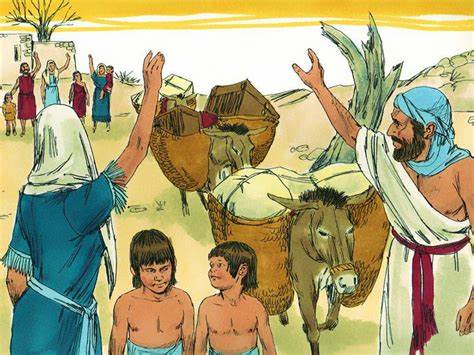
From what we know so far, Elimelek, his wife, Naomi, and their two sons were living in Bethlehem during a time of violence, unrest, and famine. So, Elimelek does what seems to be the responsible thing and transplants his family to a different area. Most of us could understand and appreciate him looking out for the welfare of his family. However, his choice of destination is questionable.
They go to Moab to live.
You may recall that Moabites were natural enemies of the Israelites. The Moabites were descendants of Moab who was born from an incestuous conception between Lot and his oldest daughter. The Moabites worshipped a god by the name of Chemosh. Worshipping him involved human sacrifice, including the sacrifice of children.[i]
King Solomon, who was granted wisdom from God, did not exercise that wisdom when it came to his choice of women. 1 Kings 11:1 NIV “King Solomon, however, loved many foreign women besides Pharaoh’s daughter—Moabites, Ammonites, Edomites, Sidonians and Hittites. 2 They were from nations about which the Lord had told the Israelites, “You must not intermarry with them, because they will surely turn your hearts after their gods.” Nevertheless, Solomon held fast to them in love.”
King Solomon not only engaged in relations with these foreign women, but he also indulged their gods and built high places for the sole purpose of worshipping the pagan gods such as Chemosh. As a result, the united Israel was divided into two kingdoms, and both were eventually destroyed, and the Israelites were taken captive by their enemies. It took many years for the Israelites to leave captivity and return to rebuild.
The Moabites were rebels and were considered a bad influence. You’d be hard-pressed to find anything positive about the Moabites in the Bible. In fact, Isaiah 25:10 gives a clear picture.
Isaiah 25:10 NIV “The hand of the Lord will rest on this mountain;
but Moab will be trampled in their land
as straw is trampled down in the manure.”
Just so there’s no misunderstanding, let me read that same passage from The Message translation.

“As for the Moabites, they’ll be treated like trash,
waste shoveled into a cesspool.
Thrash away as they will,
like swimmers trying to stay afloat,
They’ll sink in the sewage.
Their pride will pull them under.” (Isaiah 25:10 MSG)
Bottom line: Moab should not have been a destination for a God-fearing Israelite to take his family to live.
We may identify and even sympathize with Elimelek because it appears he was simply trying to remove his family from a land of confusion and chaos and famine. It could seem as if he was doing the responsible thing for his family. Nowadays, it’s not uncommon for parents to relocate due to better employment opportunities, safer areas, and even better school districts. But back in Elimelek’s days, Israelites didn’t often just up and move their immediate family without a word from God. Elimelek not only turned his back on his family, his clan, and his heritage, but he also turned his back on God by moving to and settling in a pagan area. And things didn’t quite turn out as he had hoped.
Ruth 1:3 NIV “3 Now Elimelek, Naomi’s husband, died, and she was left with her two sons. 4 They married Moabite women, one named Orpah and the other Ruth. After they had lived there about ten years, 5 both Mahlon and Kilion also died, and Naomi was left without her two sons and her husband.”

Elimelek makes the decision to move his family to a pagan territory, populated with enemies of his own people. And then he dies leaving his widow and his two sons. Becoming a widow was life-changing in multiple ways. Women rarely had the means to support themselves and any children they may have. When a husband preceded his wife in death, it was custom that a male relative of his would step in and marry the widow and raise the children or give the widow children if she had not had any. But Elimelek had moved his wife and sons so far away, there were no relatives nearby. If a woman had sons of wage-earning age, the responsibility would fall on the sons to care for their mother. If she didn’t have sons, “she might have to sell herself to slavery, resort to prostitution or die.”[ii] In this case, Naomi had two sons although we don’t know their ages when their father died. We can only assume that they were old enough to work to support her.

Living and growing up in Moab, it stands to reason that both of Naomi’s sons would marry Moabite women. Mahlon marries Ruth and Kilion marries Orpah. (Interesting tidbit of trivia: Oprah Winfrey was supposed to be named Orpah after this daughter-in-law, but her family couldn’t spell it or pronounce it. They kept putting the “p” before the “r”. [iii] Her birth certificate actually read Orpah Winfrey, but she’s always been called Oprah.)
Elimelek’s decision to escape the famine and chaos in Israelite territory put his sons in a position to marry women outside their Jewish faith which was a major no-no. In fact, Jews were forbidden to marry Gentiles. These marital unions would not have been pleasing to God. You can’t help but wonder how Elimelek and Naomi felt about it.
After ten years of living in Moab, a pagan territory, both of Naomi’s sons die. Tragedy after tragedy all because Elimelek ran from the problems. Warren W. Wiersbe said this about Elimelek’s decision. He “walked by sight and not by faith”.
Elimelek could only see circumstances in Bethlehem and the circumstances looked dire. Elimelek makes the decision to do something drastic. The saying “when the going gets tough, the tough get going” would seem to apply here. But does it? God doesn’t call us to be tough on our power. Instead, He wants us to be strengthened through Him. Over and over in the Bible, we are told that God is our Helper, God is our strength, He is our refuge, He is our Provider, our Protector, and our Guide. A lot of people like to live their lives based on the Bible verse, “God helps those who help themselves.” Fortunately for us, that verse is nowhere in the Bible and is, in fact, contrary to God’s character. But rather, God helps the helpless, the lost, and the weak. Elimelek took the easy way out. He didn’t need God for that. God doesn’t want us to take the easy route and he doesn’t want us to place our trust in ourselves.
Jeremiah 17:5 CEB couldn’t make it any clearer. “The Lord proclaims:
Cursed are those who trust in mere humans,
who depend on human strength
and turn their hearts from the Lord.”
Elimelek looked around and saw the messiness. He didn’t trust God but rather took it upon himself to “fix” the situation. He ran away from his homeland, and he ran away from God. By his own actions, Elimelek cursed himself by not having faith in God.

Have any of you ever experienced messiness in your life? You look around and all you see is chaos and confusion. You’re starving for normalcy, stability, contentment, and security. But instead of looking up, you start looking around for an escape. You look for solutions. You search for a way out, convinced that God won’t come through for you. You take matters into your own hands, do what you feel is best, and still end up in worse shape than you started.
These words are from Warren W. Wiersbe’s commentary on Ruth. “When trouble comes to our lives, we can do one of three things: endure it, escape it, or enlist it. If we only endure trials, then trials become our master, and we have a tendency to become hard and bitter. If we try to escape our trials, then we will probably miss the purpose God wants to achieve in our lives. But if we learn to enlist our trials, they will become our servants instead of our masters and work for us; and God will work all things together for our good and His glory. (Romans 8:28)”
As we go through the book of Ruth, we will see how God works all these pieces together not only for Ruth and Naomi but for us as well. And He is glorified.
Ruth 1:6 NIV “When Naomi heard in Moab that the Lord had come to the aid of his people by providing food for them, she and her daughters-in-law prepared to return home from there. 7 With her two daughters-in-law she left the place where she had been living and set out on the road that would take them back to the land of Judah.

8 Then Naomi said to her two daughters-in-law, “Go back, each of you, to your mother’s home. May the Lord show you kindness, as you have shown kindness to your dead husbands and to me. 9 May the Lord grant that each of you will find rest in the home of another husband.”
Then she kissed them goodbye and they wept aloud 10 and said to her, “We will go back with you to your people.”
11 But Naomi said, “Return home, my daughters. Why would you come with me? Am I going to have any more sons, who could become your husbands? 12 Return home, my daughters; I am too old to have another husband. Even if I thought there was still hope for me—even if I had a husband tonight and then gave birth to sons— 13 would you wait until they grew up? Would you remain unmarried for them? No, my daughters. It is more bitter for me than for you, because the Lord’s hand has turned against me!”
14 At this they wept aloud again. Then Orpah kissed her mother-in-law goodbye, but Ruth clung to her.”
Naomi is in a difficult position. She’s the sole survivor of her Jewish family in a foreign land. Somehow, she gets word that God has provided for His people back in her hometown. Did she question if the escape had been worth it? Was it the right decision? Her husband and her two sons were with her when she turned her back on God and now, it was just her. The famine, the trial that they chose to escape was over and God was now blessing her former neighbors and family members who had remained.
“How sad it is when people only hear about God’s blessing, but never experience it, because they are not in the place where God can bless them.” Warren W. Wiersbe
Have you ever been to the movies and as soon as the credits start rolling, you get up and leave because you want to avoid the rush of people exiting at the same time, only to find out later that by leaving when you did, you missed a post-credit scene or a stinger as it’s called. People might tell you about it, but it’s not the same as being there. Naomi must have felt some of that. The idea of being back home, back among family, and getting back to her roots was too tempting for her to resist. Her two daughters-in-law start off on the journey with her. But Naomi tells them to return to their mothers.
Scripture will tell us that they both resisted at first. But Naomi has nothing to offer them. You can sense the compassion and love that is felt among these women. They’ve experienced tragedy and loss together. They’ve become family. It must be heartbreaking to insist that Ruth and Orpah leave her and return to their homes. But Naomi is looking at this from a practical standpoint.
Culturally speaking, all three of them had strikes against them. They were all widowed. That title would have caused people to think less of them in a sense. Widows were often grouped together with orphans and foreigners. They weren’t considered to be of any benefit, but instead, they were more of a burden. Secondly, they were women. Women were generally thought to be considered property.[iv] Without a male family member to which they would “belong”, they would be considered the responsibility of the court.[v] They weren’t necessarily seen as contributors to society like the men were. And thirdly, Ruth and Orpah were Moabites. They were enemies of Naomi’s kinfolk. If they had gone to Bethlehem with Naomi, they would have been foreign, widowed women who came from a land of Jewish adversaries. The prejudice against them would have been great. Perhaps Naomi loved these two women so much that she didn’t want to expose them to that kind of hostility. We can appreciate that. We can understand loving someone so much that you don’t want to subject them to a life of unnecessary difficulties. But Naomi wasn’t just sparing them from a potentially unfriendly and combative way of life. Naomi was also keeping them from going to God.
Naomi wasn’t returning to her homeland because she was returning to God. She was more interested in the food. She was much more concerned with her physical hunger than her spiritual hunger. She’s so forgotten the goodness of God that she doesn’t consider her need for Him, much less the fact that her daughters-in-law need Him as well. Her main concern for them is that she has no other son for either of them to marry.
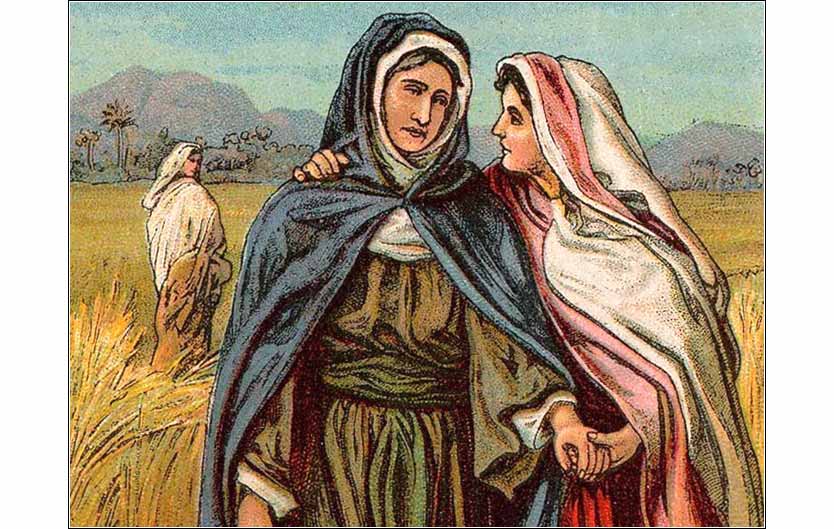
Well, it takes some convincing on Naomi’s part, but Orpah is persuaded to return to her mother’s home. Orpah is never mentioned again in the Bible.
Ruth, however, clings to Naomi. The meaning of the name Ruth is “compassionate friend”.[vi] And how Ruth lives up to that! She would have been completely justified in returning to her mother’s home, marrying someone, and having children. Instead, she clings to her mother-in-law indicating that she will not be persuaded to do anything but. And then Ruth makes a poetic pledge to Naomi.
Ruth 1:16b GNT “Let me go with you. Wherever you go, I will go; wherever you live, I will live. Your people will be my people, and your God will be my God. 17 Wherever you die, I will die, and that is where I will be buried. May the Lord’s worst punishment come upon me if I let anything but death separate me from you!”
This pledge of unwavering commitment is often used in weddings. It’s really beautiful to think of a daughter-in-law basically surrendering her life, her identity, her future, and her beliefs to her mother-in-law. Especially when you consider that Naomi doesn’t seem to be committed to God herself and yet, Ruth is willing to abandon her god Chemosh for Naomi’s God. The promise to remain with Naomi is solid. It’s sincere. It’s heartfelt. It’s permanent. The promise is given until death separates them.
It’s really a tender moment between two women that we are privileged to know about. But it’s not just a tender moment. This is a critical point in history. Ruth, nor Naomi, would have had any idea of the domino effects this one decision would have.

Romans 8:28 NKJV “And we know that all things work together for good to those who love God, to those who are the called according to His purpose.”
Despite the disobedience shown by her in-laws in escaping the trial in Bethlehem, despite her own tragedy of losing her husband, Ruth pledges herself to God and to His purpose. Naomi is drawn back to Bethlehem for food. Ruth is drawn to Bethlehem for other reasons; most of those reasons were completely unknown to Ruth. It was a step in obedience and commitment that was just the beginning of God’s purpose. Zechariah 4:10 NLT reminds us. “Do not despise these small beginnings, for the LORD rejoices to see the work begin.”
Ruth 1:18 GNT “When Naomi saw that Ruth was determined to go with her, she said nothing more.
19 They went on until they came to Bethlehem. When they arrived, the whole town became excited, and the women there exclaimed, “Is this really Naomi?”
20 “Don’t call me Naomi,” she answered; “call me Marah, because Almighty God has made my life bitter. 21 When I left here, I had plenty, but the Lord has brought me back without a thing. Why call me Naomi when the Lord Almighty has condemned me and sent me trouble?”

22 This, then, was how Naomi came back from Moab with Ruth, her Moabite daughter-in-law. When they arrived in Bethlehem, the barley harvest was just beginning.”
Naomi is so resentful, so disgruntled at the way her life has become, she changes her name from Naomi which means “pleasant” to Mara which means “bitter”. Her circumstances were not what she wanted them to be, and she couldn’t move beyond the disappointment she felt because she lacked faith in God.
“Twice Naomi called God ‘The Almighty,’ which is the Hebrew name El Shaddai,’ ‘the All-Powerful One. It’s one thing to know God’s name and quite something else to trust that name and allow God to work in the difficult situations of life.”[vii]
Mara (or Naomi) has no idea what God has in store for her and Ruth. She doesn’t have a clue that her difficult circumstances have a purpose. She is so unaware of how her story and her life are fitting into God’s plan. All she knew was she needed to get out of Moab.
Moab was an actual place for Mara but it can also be a metaphor for us.
Liz Curtis Higgs said this. “In the same way and for the same reason, you and I need to leave the Moabs of our own making. Whether it’s a place we don’t belong or a relationship going in the wrong direction or an activity we’re ashamed of or a habit that’s strangling us, we need to get out of Moab.”[viii]
We love the story of Ruth and over the next few weeks, we’ll take a closer look at how God orchestrates her encounters and her circumstances. God is going to bless her in ways she could not have imagined. But God is also going to cause Naomi to put her trust in Him again. She’s going to be able to see His hand move, and she will be blessed. All it took was leaving Moab and returning home. Back to God.
[i] https://www.learnreligions.com/chemosh-lord-of-the-moabites-117630
[ii] NKJV, Cultural Backgrounds Study Bible by Craig Keener, John Walton
[iii] https://www.aol.com/article/2015/08/28/oprah-wasnt-always-oprah-her-birth-name-revealed/21228783/
[iv] https://www.worldhistory.org/article/1812/women-in-the-old-testament/#Women%20as%20Property
[v] https://www.biblegateway.com/resources/encyclopedia-of-the-bible/Widow#:~:text=In%20actual%20practice%20the%20lot%20of%20the%20widow,is%20supplied%20with%20food%20and%20clothing%20%28Deut%2010%3A18%29.
[vi] https://nameberry.com/babyname/ruth
[vii] Be Committed by Warren W. Wiersbe
[viii] The Girl’s Still Got It by Liz Curtis Higgs
 Beacons of Light