Before our time, a thirteen-year-old girl, along with her parents and older sister, took refuge in a secret annex in the building of her father’s business. Her diary, which detailed her thoughts, her fears, and her dreams was published. We know it as The Diary of Anne Frank.
The year was 1942. Anne’s family had previously left Germany after the Nazis had taken control and had settled in the Netherlands. Their security and safety were soon threatened when German authorities began “rounding up Jews and ultimately deported them to killing centers.”[i]
For 25 months, Anne and her family remained hidden away, safe from the Gestapo. During those two-plus years, only a few people knew of Anne and her family’s whereabouts. One of them was a woman by the name of Miep Gies. Miep worked for Anne’s father, Otto. Miep and her husband, Jan, brought in food, newspapers, and books to the refugees. “In addition to the daily care for the eight people in hiding (the Van Pels family and Fritz Pfeffer joined the Frank family in the Secret Annex), the work for the company had to continue as normal as possible.”
After Anne and her family were captured and taken into custody in August of 1944, Miep discovered Anne’s writings and hid them away for safekeeping. Unfortunately, Anne passed away in 1945 and upon her death, Meip handed the diary over to Anne’s father – the only surviving member of their family.
Chances are, you’ve never heard of Miep Gies. Her name doesn’t invoke images of bravery or loyalty. But had it not been for Miep Gies, The Diary of Anne Frank would have never been known to us. In fact, the name, Anne Frank, would mean nothing to us.
Miep Gies was placed at the right time, in the right place, with the right attitude to make a difference.
Providence. It’s defined as “timely preparation for future eventualities”.[ii]



So far in Esther, we’ve seen some timely preparations for future eventualities. Things that didn’t seem connected to one another, are proving to be dominoes in carrying out God’s plan.
In Chapter 1, Queen Vashti refused to make a grand entrance at the demand of her husband, King Xerxes.
Queen Vashti is ripped of her crown and status. That leaves the position of queen open.
Chapter 2 picks up after King Xerxes unsuccessfully battles the Greeks and returns to his throne. Despite having a harem of concubines, he longs for a queen. Young, beautiful virgins from across the 127 provinces are summoned and Esther, a Jewish orphan is selected from among the hundreds. Esther’s guardian and cousin, Mordecai, takes a position with the king that puts him in a position to keep an eye on Esther from a distance.
Chapter 3 introduces us to the antagonist of the story. Haman. A self-serving, pompous, and manipulative high-ranking official of King Xerxes. Once Haman is appointed, King Xerxes makes it a law that others are to bow to Haman. It was this law and Mordecai’s refusal to bow that revealed Mordecai’s Jewish ancestry. The disrespect caused Haman to seek revenge, not just on Haman, but all of the Jews living in King Xerxes’ kingdom.
Haman comes up with a plan and presents it to King Xerxes. The Jews must be destroyed, and Haman is willing to provide reward money to those who carry out his wish. An order is made and sent out to the important officials in the provinces stating that all Jews, from men, women, and children, are to be killed on a particular day. The order was declared in King Xerxes’ name and sealed with his signet ring which had been entrusted to Haman. While King Xerxes and Haman sat down for a cocktail, the rest of the kingdom scrambled to make sense of it all.
That brings us to Chapter 4.

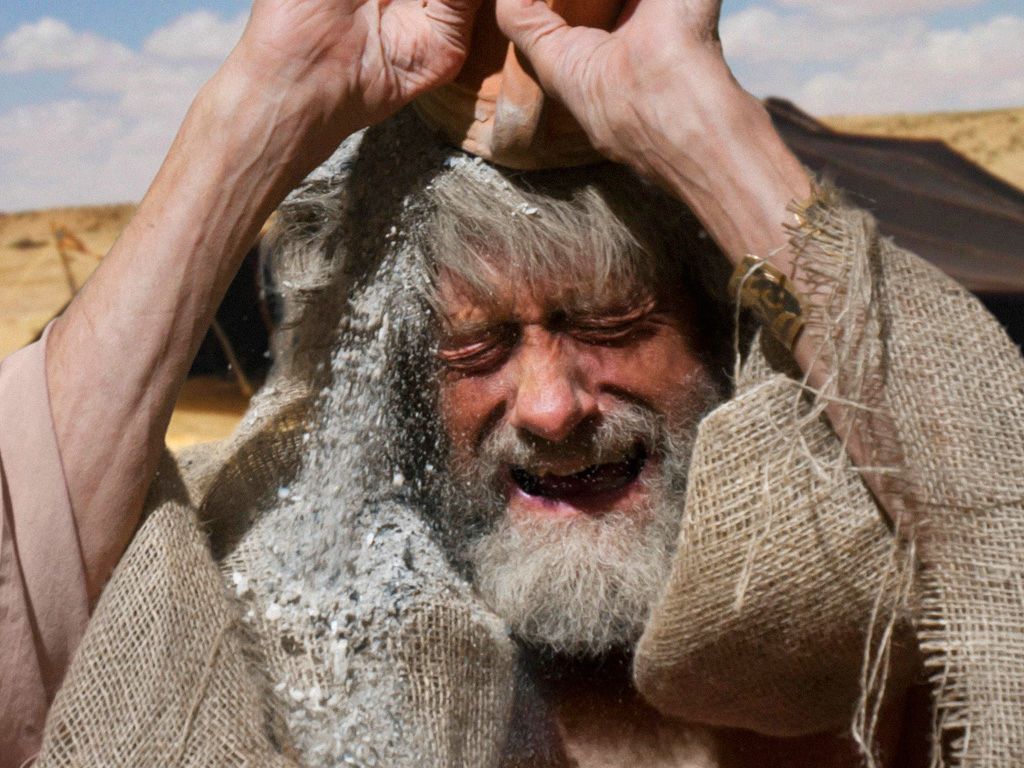
“Now Mordecai heard about all that had been done. To show how upset he was, he tore his clothes. Then he put on rough cloth and ashes. And he went out into the city crying loudly and very sadly. 2 But Mordecai went only as far as the king’s gate. This was because no one was allowed to enter that gate dressed in rough cloth. 3 The king’s order reached every area. And there was great sadness and loud crying among the Jews. They gave up eating and cried out loudly. Many Jews lay down on rough cloth and ashes to show how sad they were.” (Esther 4:1 ICB)
Mordecai is distraught. He’s mourning. He is expressing grief. But his demonstration goes only as far as the king’s gate. No one dressed in sackcloth, or clothes indicating sorrow or grief was permitted to enter the king’s area. There was an expectation of euphoria or an idyllic bubble surrounding the king. The sad truth about the realities of life was to be kept on the outside. George H. Morrison wrote, “They must have a good time at any cost. They must live their easy and comfortable lives, as if there were no voices calling them.”[iii]
It’s cruel to think that Haman issued the death sentence for Jews, with the king’s permission, but didn’t want to witness the devastation of the news. Mordecai, along with the others, is devastated. There is wailing. Many have joined Mordecai in wearing sackcloth and ashes. And there is fasting.
Fasting was most often coupled with praying to God.[iv] However, there is no mention of prayer. That’s certainly not to imply that no one was praying, but if prayer was mentioned, that would reference God. And the absence of direct mentions of God is what sets this book apart from the others in the Bible. The fact that no reference to God is made and yet, we have the benefit of knowing that He is most definitely involved in even the most minute details should encourage us. So often, we pour our hearts out to Him, and we hear nothing but deafening silence. When God doesn’t speak or act when we expect, we consider ourselves forgotten, or overlooked by Him.
You may recall that Martin Luther wasn’t shy about expressing his disdain for the book of Esther. But Martin Luther himself went through a time of grief and sadness much like Mordecai and the other Jews in Esther. “One time, when Luther was especially depressed, Katie [his wife] dressed all in black. Luther noticed and asked if she were going to a funeral, Katie replied, ‘you were so despondent, I thought that God had died.’ Katie’s actions helped Luther again focus on his God and Savior rather than his temporary problems.”[v]
Have you experienced periods in your life in which it feels as if it is catastrophe after catastrophe? Times in which you can barely recover from one incident before something else takes your breath away. When you’re experiencing moments like that, it’s hard to see God, to feel Him, and to trust Him. But you most likely had someone on the outside of your circumstances reassuring you that God was still in control. Someone who was confident that God’s providence was paving the road of your life.
That’s part of who we are supposed to be for each other. Encouragers and reminders of God’s sovereignty and His love for each of us individually and corporately. Paul writes to the Romans “What I mean is that both you and I will be helped at the same time, you by my faith and I by yours.” (Romans 1:12 GNT)
Mordecai is not alone in his grief and despondency. The other Jews are confused, rattled, and terrified. But we have to wonder if Mordecai was feeling some responsibility and regret for all that was happening. After all, it was his defiance that angered Haman. And that anger is what prompted Haman to take it out on all Jews. But what could Mordecai do? Was his demonstration of grief carried out so that word would reach Esther? If so, then he was successful.
Esther 4:4 ICB “Esther’s servant girls and eunuchs came to her and told her about Mordecai. Esther was very upset and afraid. She sent clothes for Mordecai to put on instead of the rough cloth. But he would not wear them. 5 Then Esther called for Hathach. He was one of the king’s eunuchs chosen by the king to serve her. Esther ordered him to find out what was bothering Mordecai and why.”

At first, Esther does what many of us do. She tries to fix a situation without knowing the details. She sends new clothes for him to wear. Without getting to the root of the problem, Esther simply tries to cover it up. A quick and easy fix. “Our human nature not only sets us up for selfishness but to feel uncomfortable and incompetent when faced with someone who needs more than we have.” (Beth Moore)[vi] But Mordecai knew that a change of clothing wasn’t going to fix this. He, therefore, refuses the clothes sent to him by Esther. This simple act presents a catalytic opportunity to cause something significant. A “timely preparation for future eventualities”.[vii]
God’s providence at work.
Mordecai’s refusal of the clothing spurs Esther to inquire about what has him so upset. Esther is living inside the idyllic bubble. She’s behind the gate and has no idea as to what has taken place. She isn’t aware that a bounty has been placed, unknowingly, on her own head should her genetic makeup be discovered.
Now enters Hathach – the Miep Gies of Esther’s story.
Hathach is enlisted to find out what’s going on with Mordecai. He needs to bring the news of the outside world inside the king’s gate to Esther.
Esther 4:6 GNT “6 Hathach went to Mordecai in the city square at the entrance of the palace. 7 Mordecai told him everything that had happened to him and just how much money Haman had promised to put into the royal treasury if all the Jews were killed. 8 He gave Hathach a copy of the proclamation that had been issued in Susa, ordering the destruction of the Jews. Mordecai asked him to take it to Esther, explain the situation to her, and have her go and plead with the king and beg him to have mercy on her people. 9 Hathach did this,”
Imagine Hathach’s position here. He’s taken on the role of secret messenger between Esther and Mordecai and the message that he’s given to deliver is horrific. And, he’s told by Mordecai that the Jews are Esther’s people. This would have revealed the fact that Esther was a Jew.
Warren W. Wiersbe said this of Hathach. “I doubt that Hathach realized what an important part he was playing in God’s plan to defeat Haman and save the Jews. So often in the work of the Lord. He uses obscure people to accomplish important tasks. What was the name of the lad who gave Jesus his loaves and fish? Who were the men who rescued Paul by lifting him over that Damascus wall in a basket? What was the name of the little servant girl who told Naaman to go see the prophet? We don’t know, but God used these people to accomplish His purposes. As great doors can swing upon small hinges, so great events can turn upon the deeds of ‘small’ and sometimes anonymous people.”[viii]
Mordecai asks that Esther speak with her husband, the king. Seems like an easy task, but it was anything but easy. Royal protocol didn’t allow for anyone, including the Queen, to just pop in for a visit. She responds to Mordecai through Hathach by saying , 11 “If anyone, man or woman, goes to the inner courtyard and sees the king without being summoned, that person must die. That is the law; everyone, from the king’s advisers to the people in the provinces, knows that. There is only one way to get around this law: if the king holds out his gold scepter to someone, then that person’s life is spared. But it has been a month since the king sent for me.” (Esther 4:11 GNT)

Queen Esther isn’t making excuses or saying, “I just don’t wanna do it.” Her response is practical and reasonable. If she does as Mordecai suggests, not only will the message not get delivered to the king, but she’ll be killed. There’s also some concern on her end that she’s not been summoned by King Xerxes for a month. Has she fallen out of favor with him? Has he found himself not desiring her company for some reason? She’s in a quandary.
Mordecai understands her position, but he also understands that “to stand by and do nothing out of self-preservation is to be dead already.” (Beth Moore)[ix] He needs to shock Esther with a slap of reality.
Esther 4:12 GNT “12 When Mordecai received Esther’s message, 13 he sent her this warning: “Don’t imagine that you are safer than any other Jew just because you are in the royal palace. 14 If you keep quiet at a time like this, help will come from heaven to the Jews, and they will be saved, but you will die and your father’s family will come to an end. Yet who knows—maybe it was for a time like this that you were made queen!”
Esther, his cousin whom he loved, needs to know that she is not immune from Haman’s wrath. Her residency inside the king’s gate will not exclude her from annihilation. If it’s discovered that she is Jewish, it won’t matter that she wears a crown. And here’s where Mordecai’s faith in God’s providence explodes. Mordecai tells her that if she doesn’t act, God will use someone else to carry out His will. Mordecai has faith that God will protect His people with or without Queen Esther’s involvement. It’s “either you do it, Esther, or God will employ someone else”.
The message that Mordecai is relaying to Esther is that God has purposes of which we aren’t always aware. God’s ways are often intricate and intertwined and there is no possibility that we can see it all nor understand it all. God works with us individually and God works with us corporately. And He works it all together for His purposes. Free will permits us to remove ourselves from participating, but that by no means indicates that His plan won’t be carried out. “If you and I refuse to obey God, either He can abandon us and get someone else to do the job, and we will lose the reward and blessing, or He can discipline us until we surrender to His will.” (Warren W. Wiersbe)
Job 42:4 NIV ““I know that you can do all things; no purpose of yours can be thwarted.” God’s going to do what God wants to do when He wants to do it and how He wants to do it. We are either on His playing field or sitting on the sidelines. That’s our choice. When He calls us to the playing field, that’s not the time to sit and ponder, “Well, I might get tackled” or “I may have to run” or “I never get to carry the ball, so why bother?” Out of 11 players on the football field, (and yes, I did have to look that up!), everyone has a role, a task, an assignment. If someone’s not doing their part, they’ll get replaced.

So Mordecai hits hard with this one statement. “And who knows, you may have gained your royal position for a time like this.” (Esther 4:14 GNT)
Esther, who has had favor shown to her that put her in this position, has the blinders removed from her eyes. That one sentence enables Esther to see beyond reason, to look past what’s easiest and safest, and to consider that God may be using her. Maybe this particular moment is what the past few years have led up to. She now has an opportunity to do something significant and historical.
“Kairos (pronounced “KAI-ros”) in Ancient Greek meant “time” – but it wasn’t just any time. It was exactly the right time to say or do a particular thing. In modern rhetoric, it refers to making exactly the right statement at exactly the right moment.”[x]
We may consider Kairos as “ah-ha” moments when someone says or does something that makes things seem clearer. This was Queen Esther’s “ah-ha” moment.
But Esther also is very much aware that this Kairos, or this ah-ha moment may cost her dearly.
Esther 4:15 ERV “15-16 Then Esther sent this answer to Mordecai: “Mordecai, go and get all the Jews in Susa together, and fast for me. Don’t eat or drink for three days and nights. I and my women servants will fast too. After we fast, I will go to the king. I know it is against the law to go to the king if he didn’t call me, but I will do it anyway. If I die, I die.”
17 So Mordecai went away and did everything Esther told him to do.”
This was a critical moment. Mordecai is desperate. The Jews are despondent. And Queen Esther is now determined. She knows what she’s about to do is risky. She knows that although all Jews are being threatened, she’s about to put her own head on the chopping block and she has no idea whether or not she’ll make a difference. Esther is called on to make a sacrifice and she asks for help. She requests that Mordecai gather up the Jews and fast on her behalf for three days and nights. She and her servant girls will do the same.
Mordecai is desperate. The Jews are despondent. And Queen Esther is now determined.
“Esther accepts this challenge. Notice that she makes no reference to prayer, only to fasting. The strange providences of God are becoming evident, and there is revealed a confidence in the unnamed One.”[xi]
You may recall that Esther was able to become queen because she and Mordecai were not living as Jews. They had easily blended in with their pagan neighbors. When faced with bowing down to Haman, Mordecai revealed his Jewish heritage. He is now asked by Esther to round up the Jews in Susa and corporately fast and pray on her behalf. And Esther is going to turn to her Gentile servants and ask them to do the same. Imagine their response when their queen whom they assume to be a Gentile commands them to fast and pray to the Jewish God.

Not only that, but we must consider when this command to fast was made. Haman sadistically had the decree announced on the eve of Passover, one of the Jews’ most celebrated holidays. Now, just as Jewish families sat down for a mournful meal after hearing the news of Haman’s orders to have them killed, they are asked to skip their meal and fast.
Back in 2020 when we are making adjustments because of COVID, so many people complained about not being able to gather with their families and have their traditional meals. Can you just imagine if we had been asked to spend Thanksgiving and two additional days fasting and praying? But there’s no mention of the Jews complaining or whining or bellyaching. They knew that God was their only answer, and they too were willing to sacrifice.
God may not be named in this book, but His presence is evident.
God may not be mentioned in our world, but His presence is evident.
There are too many things going on in this world that we must recognize our purpose in standing up and speaking out when prompted by the Holy Spirit.
Ecclesiastes 3:7b NIV “a time to be silent and a time to speak” reminds us that there are times in which we need to be quiet, but God often provides opportunities for us to speak out on His behalf.
Standing up and speaking out and taking advantage of those opportunities is often uncomfortable and requires sacrifice. But here’s the truth. If you find yourself in a position in which you have an opportunity to seize your Kairos, your divine opportunity, and you stay seated and keep your lips closed, God will use someone else. Do we run the risk of being shunned or unfriended because of it? It’s absolutely possible. But if you die, you die. Mark 8:35 ESV “For whoever would save his life will lose it, but whoever loses his life for my sake and the gospel’s will save it.”
Miep Gies and her husband risked their lives to protect 8 Jewish people. Anne Frank wrote in her diary: “How wonderful it is that nobody need wait a single moment before starting to improve the world.”
We should be willing to share the Good News of God to protect our family, our neighbors, and our communities without hesitation. Perhaps you were created for just such a purpose at a time such as this.

[i] https://encyclopedia.ushmm.org/content/en/article/anne-frank-diary
[ii]https://www.bing.com/search?q=providence+definition&toWww=1&redig=A8693EA1C7444A018F773910DA26679F
[iii] The Afterglow of God by George H. Morrison
[iv] https://bible.org/seriespage/chapter-1-fasting-old-testament-and-ancient-judaism-mourning-repentance-and-prayer-hope-g
[v] https://credomag.com/2019/10/women-of-the-reformation-katie-luther/
[vi] Esther: It’s Tough Being a Woman by Beth Moore
[vii]https://www.bing.com/search?q=providence+definition&toWww=1&redig=A8693EA1C7444A018F773910DA26679F
[viii] Be Committed by Warren W. Wiersbe
[ix] Esther: It’s Tough Being a Woman by Beth Moore
[x] https://literaryterms.net/kairos/
[xi] https://www.blueletterbible.org/comm/mcgee_j_vernon/notes-outlines/esther/esther-outline.cfm
 Beacons of Light